Types of Flowers: 40 Blooms to Know—and Which Belong in Bouquets
A visual-minded guide to recognizing popular flowers and understanding what each one contributes to the structure and mood of a bouquet.
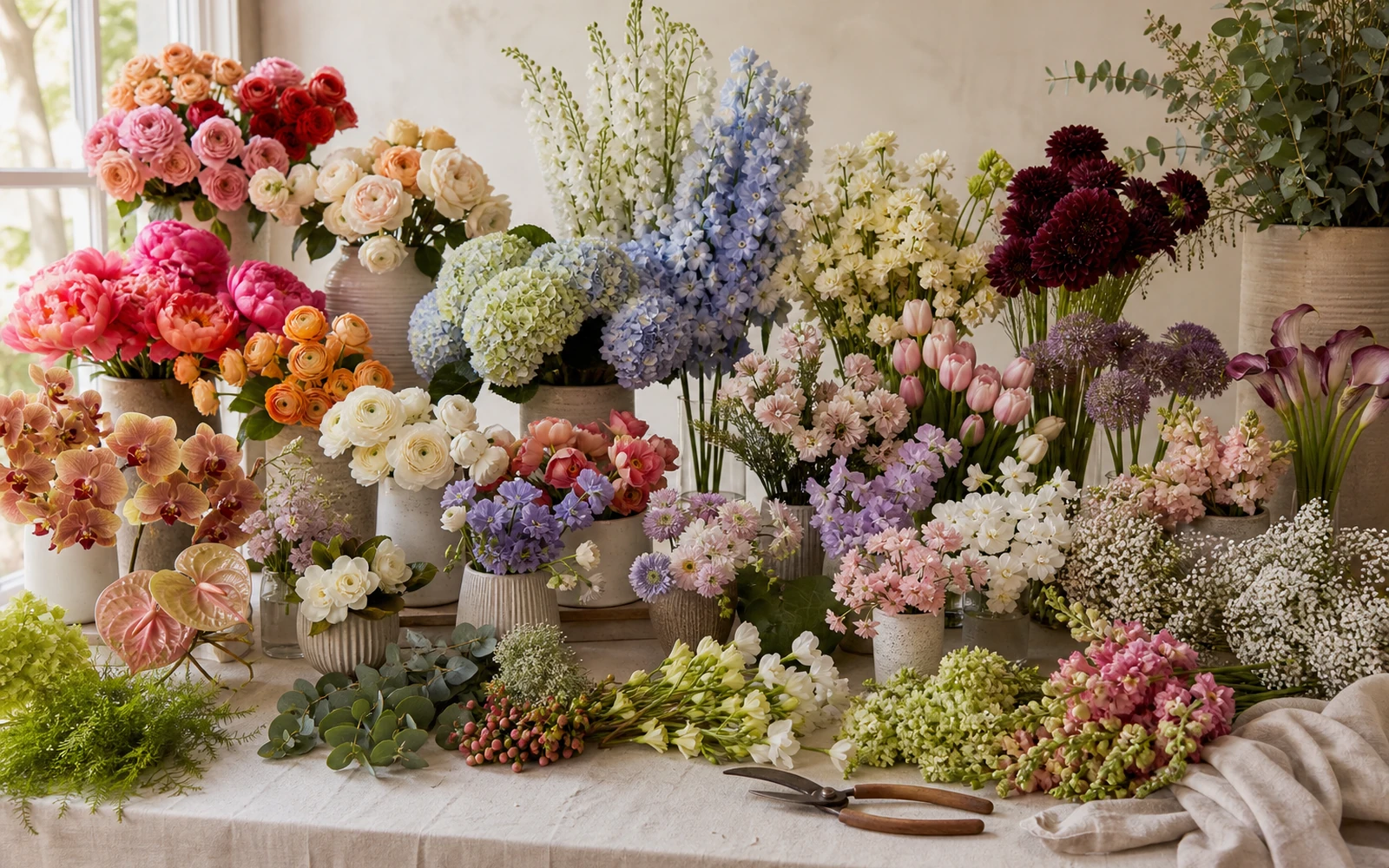
The 40 types of flowers worth knowing for bouquets are roses, peonies, ranunculus, dahlias, hydrangeas, sunflowers, proteas, gardenias, tulips, anemones, poppies, daffodils, irises, gerberas, calla lilies, camellias, delphiniums, snapdragons, stock, gladiolus, larkspur, veronica, liatris, bells of Ireland, carnations, chrysanthemums, lisianthus, alstroemeria, Asiatic lilies, freesia, sweet peas, hellebores, baby’s breath, waxflower, statice, astilbe, scabiosa, orchids, anthuriums, and bird of paradise.
That list becomes useful when you stop memorizing names and start seeing architecture. Some flowers anchor the eye. Some build height, volume, air, or movement. Others interrupt the bouquet with one unforgettable shape. When the choice is about symbolism rather than structure, use the flower meanings guide as the companion hub.
Use this quick visual map:
- Need one commanding center? Rose, peony, dahlia, sunflower, protea.
- Need fast volume? Hydrangea, chrysanthemum, carnation, Asiatic lily.
- Need height? Delphinium, snapdragon, gladiolus, stock.
- Need air between larger flowers? Baby’s breath, waxflower, statice, astilbe.
- Need a modern sculptural note? Calla lily, orchid, anthurium, bird of paradise.
Jump to any of the 40 flowers
Browse Rosa Fiora bouquets by flower and mood while you read. A finished design makes the roles easier to see than an isolated bloom ever will.
One flower can change jobs with scale and placement. “Focal,” “line,” “mass,” “filler,” and “form” are florist decisions—not botanical families. The recognition cues were cross-checked against the NC State Extension Plant Toolbox and Missouri Botanical Garden Plant Finder; the bouquet roles are my design reading.
The anchors: eight flowers that hold the gaze
These are the blooms people notice first. They can stand alone, repeat in a lush mass, or give a mixed bouquet its visual center.
1. Rose — the layered rosette
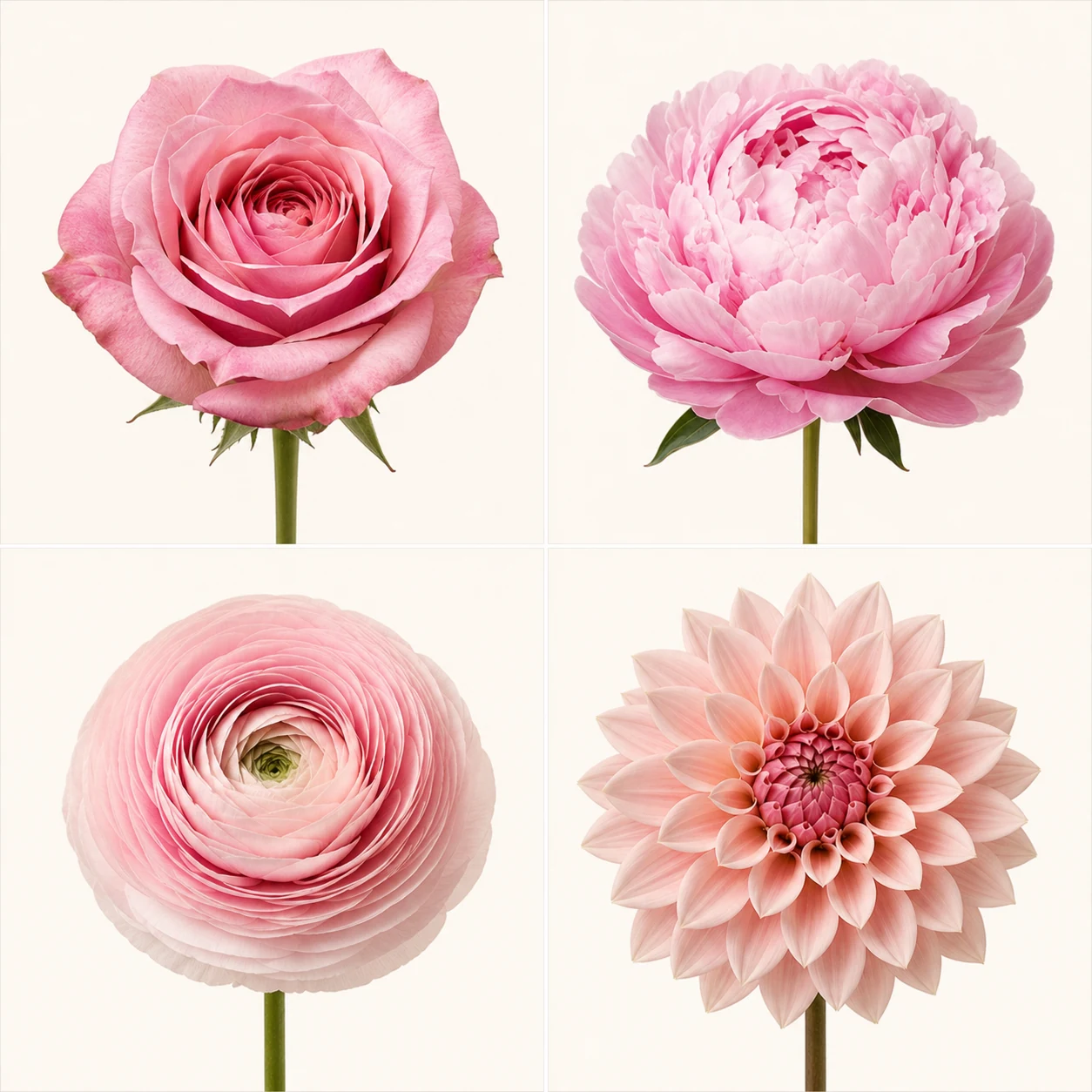
Follow the petals inward: a rose usually builds a spiral or rosette around a clear center, from tight classic heads to loose, deeply layered forms. Bouquet role: one rose can be a focal point; repeated roses create a smooth, romantic mass and a strong color field.
2. Peony — the soft, oversized cloud
A peony begins as a rounded bud and opens into a broad bowl or a densely petaled sphere with a softer, less geometric edge than a dahlia. Bouquet role: lush focal flower. Give it space to open; crowding erases the very volume you chose it for.
3. Ranunculus — the precise paper spiral
Ranunculus packs many thin petals into tight concentric rings. It often reads like a smaller, crisper cousin to the peony. Bouquet role: detailed focal or bridge flower, especially when a bouquet needs romance without one oversized bloom dominating the shape.
4. Dahlia — geometry in petals
Look for orderly rows, a ball or pompon silhouette, or narrow cactuslike petals radiating from the center. Bouquet role: graphic focal. A single dahlia can sharpen a loose garden bouquet; a cluster can make the entire design feel patterned and deliberate.
5. Hydrangea — one head, hundreds of small moments
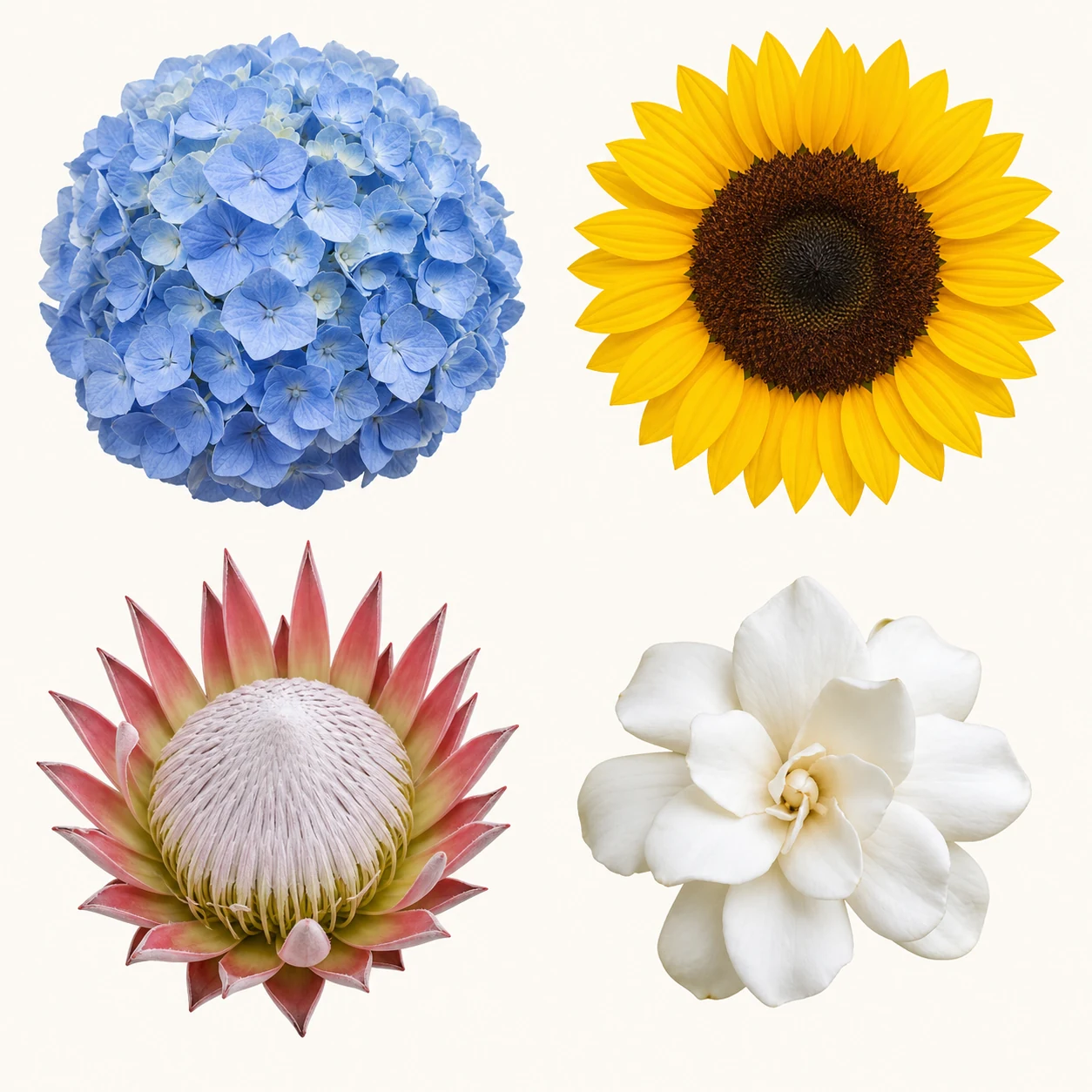
What looks like one giant flower is a rounded or conical cluster of many small florets. Bouquet role: volume builder. Hydrangea fills space quickly, softens mechanics, and creates a cushion behind more defined focal blooms.
6. Sunflower — the unmistakable disk
A sunflower has a broad central disk ringed with radiating petals, usually on a strong stem. Bouquet role: bold focal and instant visual theme. Pair it with quieter texture if you want the face to remain commanding rather than competitive.
7. Protea — the architectural crown
Protea reads through structure: a substantial center surrounded by firm, pointed or cupped bracts. Bouquet role: statement form flower. It introduces weight, texture, and a wild sculptural authority that can carry an otherwise restrained arrangement.
8. Gardenia — the fragrant ivory rosette
Gardenia has thick, waxy petals folded into a compact creamy rosette and an unmistakably rich fragrance. Bouquet role: close-view accent rather than broad filler. It belongs where one immaculate bloom can be noticed—in a compact bouquet, detail piece, or low arrangement.
A peony-led mixed bouquet makes several anchor roles visible in one composition: peonies hold the gaze, hydrangea builds the volume beneath them, and orchids create lighter points around the mass.
Clean faces, cups, and silhouettes
This group is easier to recognize from the outline than from petal count. Each flower gives the bouquet a clear visual mark.
9. Tulip — the moving cup
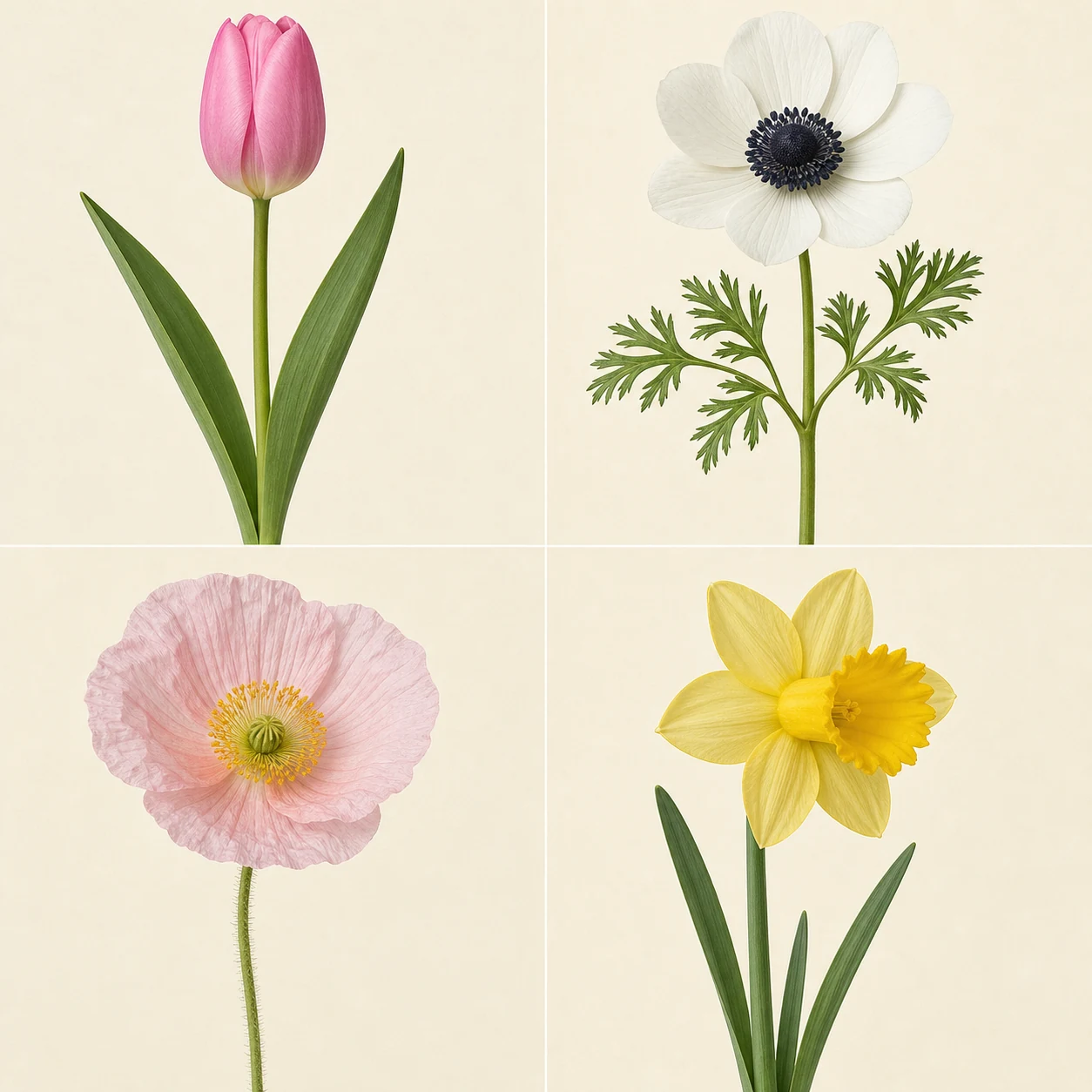
Tulips begin as smooth cups, then open wider as their clean stems continue to curve and reach. Bouquet role: rhythmic mass or minimalist focal. Repeated tulips create movement without needing filler between every stem.
10. Anemone — the eye at the center
An anemone opens into a broad face around a dramatic center, often dark but sometimes pale or green. Bouquet role: contrast focal. I use that center like punctuation: a few blooms can wake up a soft palette immediately.
11. Poppy — the paper-thin face
Poppies carry crinkled, tissue-thin petals around a strong central disk, often with visible stamens. Bouquet role: airy focal. Their delicacy brings life and motion, but they are not the flower I choose when a design must look rigidly uniform.
12. Daffodil — the spring trumpet
A daffodil shows a central trumpet or cup surrounded by a flatter ring of petal-like segments. Bouquet role: seasonal accent or cheerful mass. Its profile is clearest when the heads can turn in several directions rather than being packed into a tight dome.
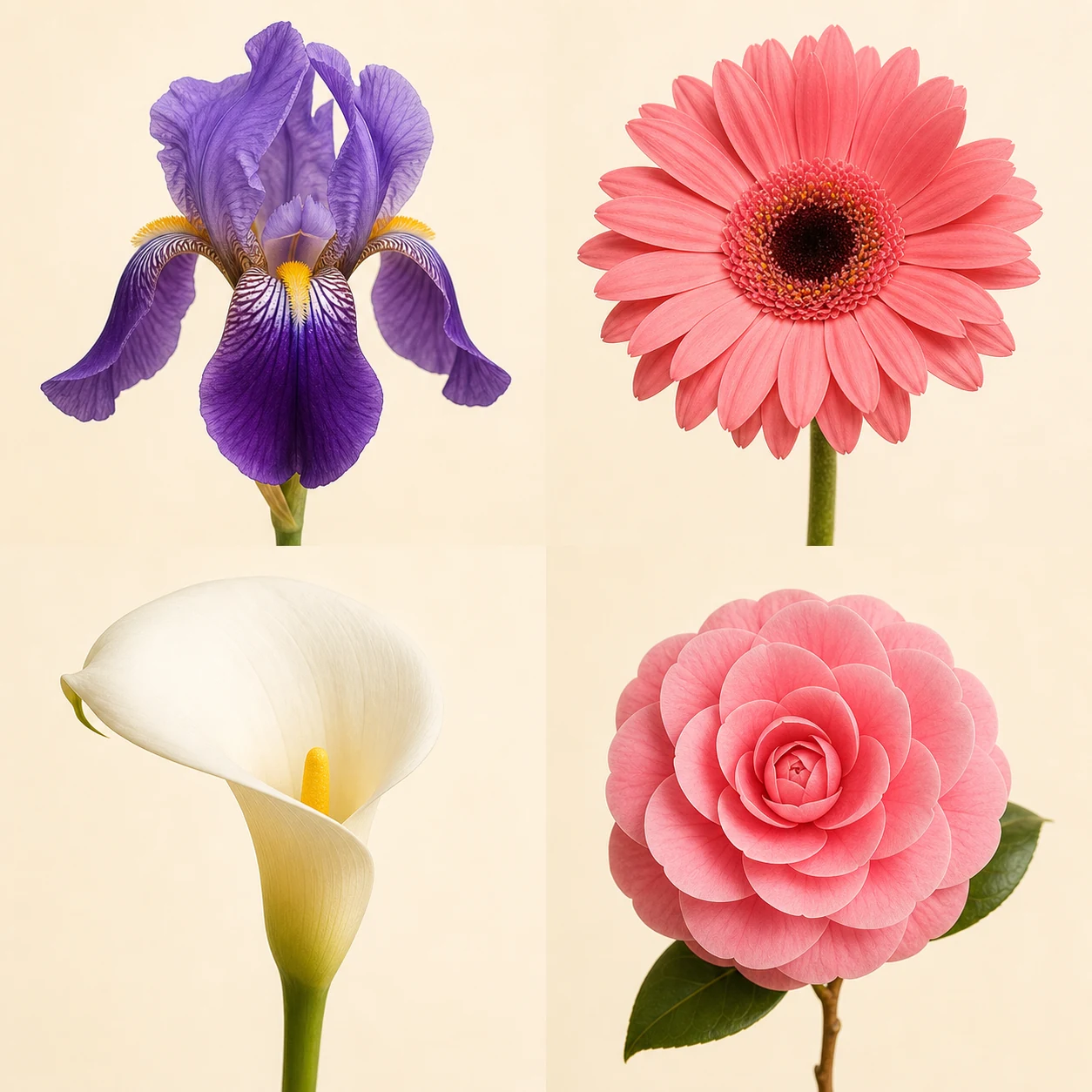
13. Iris — the folded, angular bloom
Iris flowers combine upright inner petals with outer petals that fall or flare downward, creating an angular, almost winged silhouette. Bouquet role: line-focal hybrid. The stem adds lift while the flower face introduces a sharp directional turn.
14. Gerbera — the clean graphic disk
Gerbera is the polished daisy face: a broad disk, radiating petals, and a mostly leafless stem. Bouquet role: graphic focal or repeated pop of color. It suits designs that need clarity and playfulness more than petal-heavy softness.
15. Calla lily — the sculpted funnel
The “petal” appearance is a single funnel-like spathe wrapped around a central spike. Bouquet role: sculptural line and form. One calla can draw a clean arc; several can make a bouquet feel tailored and architectural.
16. Camellia — the polished garden rosette
Camellia blooms range from open forms with a visible ring of stamens to precise layered rosettes, all with a polished petal surface. Bouquet role: refined close-view accent. It creates intimacy rather than bulk and is most convincing where guests can appreciate the flower at arm’s length.
The verticals: flowers that draw the bouquet upward
A round bouquet can become visually heavy. These eight stems change its posture by creating height, rhythm, and direction.
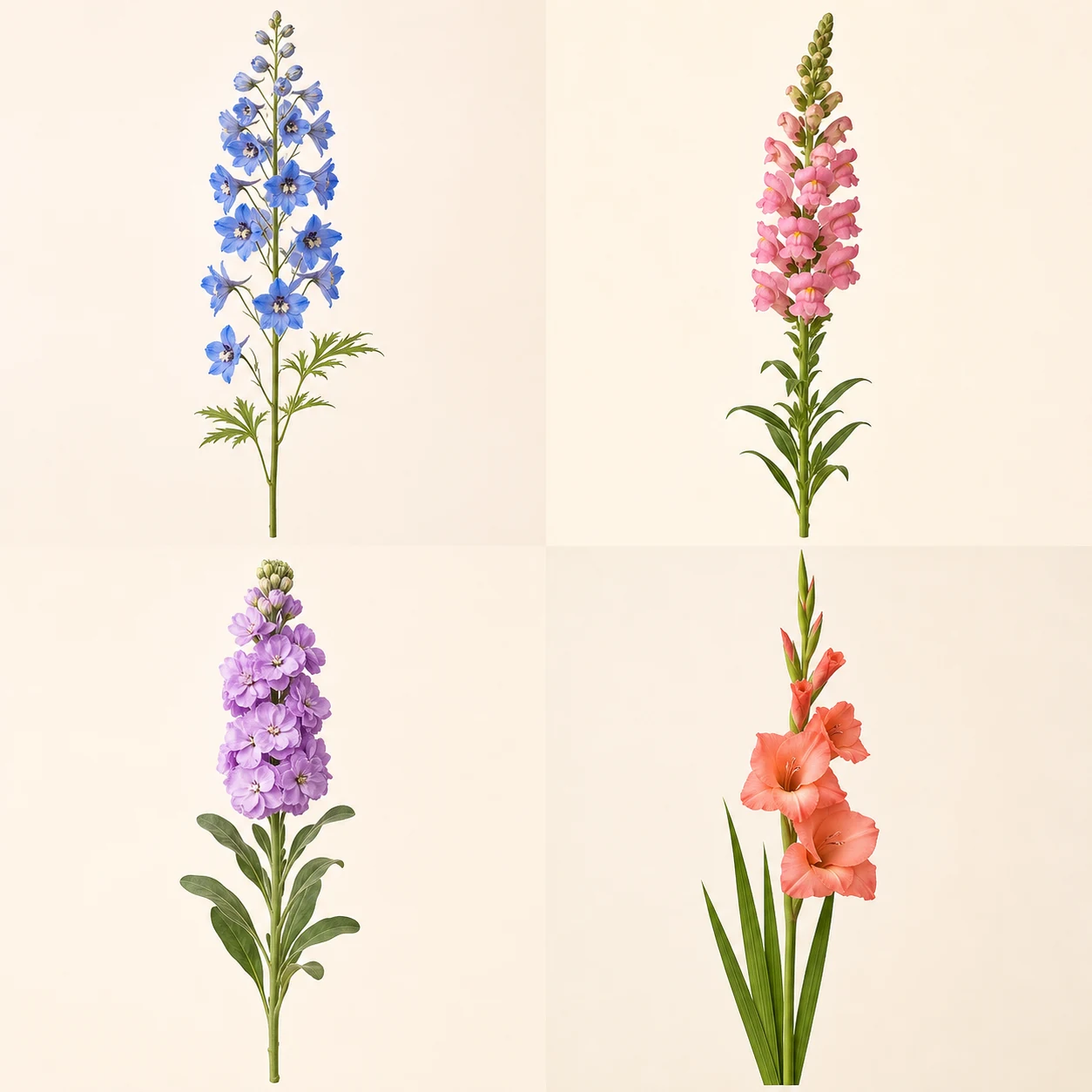
17. Delphinium — the tall open spire
Delphinium stacks many open florets along a long upright stem, with enough space between blooms to keep the line visible. Bouquet role: height and airy vertical structure. It can lift a garden arrangement without making the upper edge feel solid.
18. Snapdragon — the dense flowering column
Snapdragon florets hug an upright spike and resemble tiny mouths when viewed closely. Bouquet role: dense line flower. It gives a bouquet a firmer, more continuous vertical than delphinium.
19. Stock — the fragrant column
Stock carries clusters of four-petaled flowers up a sturdy central stem, often with a spicy fragrance. Bouquet role: line plus mass. It connects low rounded blooms to taller spires while adding petal density through the middle.
20. Gladiolus — the dramatic blade
Gladiolus sends a succession of large trumpetlike blooms up one side of a powerful stem. Bouquet role: dramatic line. It belongs in designs with enough scale to absorb its length—large vase arrangements, ceremony pieces, and confident modern compositions.
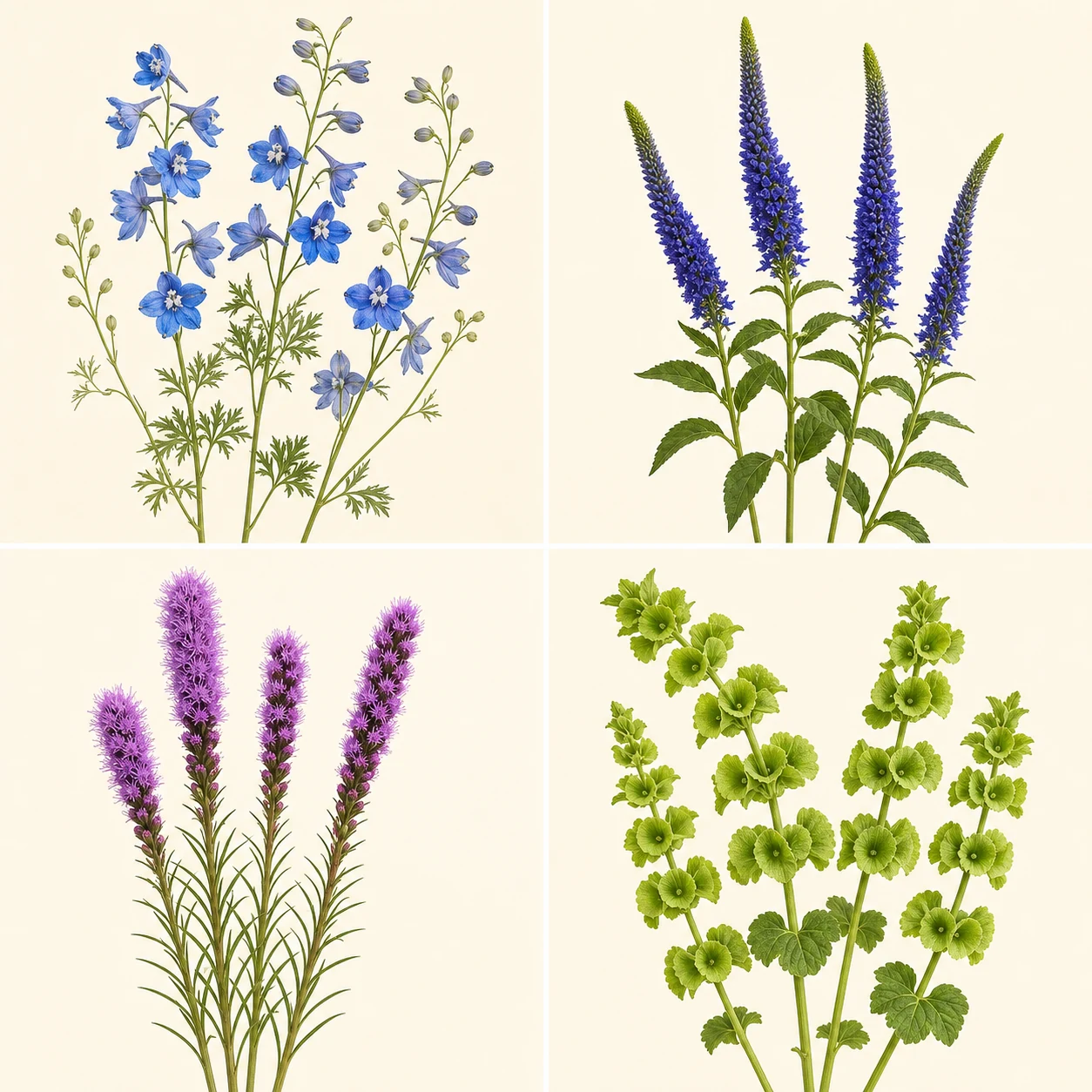
21. Larkspur — the loose branching tower
Larkspur is slimmer and more branching than the heaviest delphinium stems, with small spurred flowers spaced along airy growth. Bouquet role: loose line. It creates meadowlike height rather than a formal column.
22. Veronica — the fine tapered stroke
Veronica forms a narrow taper of tiny florets, like a soft brushstroke rising above rounder flowers. Bouquet role: fine line and gesture. I use it to repeat a color lightly without adding another broad flower face.
23. Liatris — the fuzzy wand
Liatris is recognizable by its narrow bottlebrush texture and upright, often purple or white flower spike. Bouquet role: textural line. It brings a stronger, more graphic vertical than veronica while keeping the footprint slim.
24. Bells of Ireland — the green ladder
Its “bells” are green, cup-like calyces stacked up a tall stem, with tiny true flowers tucked inside. Bouquet role: green line and space-maker. It divides color blocks and makes a mixed arrangement feel fresher and less crowded.
A blue-and-pink mixed arrangement shows how orchids and stock lift the silhouette above rounded hydrangea, roses, and peonies. The lighter stems change the posture without turning the upper edge into a solid wall.
Petal-rich supporting players
These flowers do more than fill gaps. They connect focal blooms, carry color through the middle, and keep the design from looking like a collection of isolated stars.
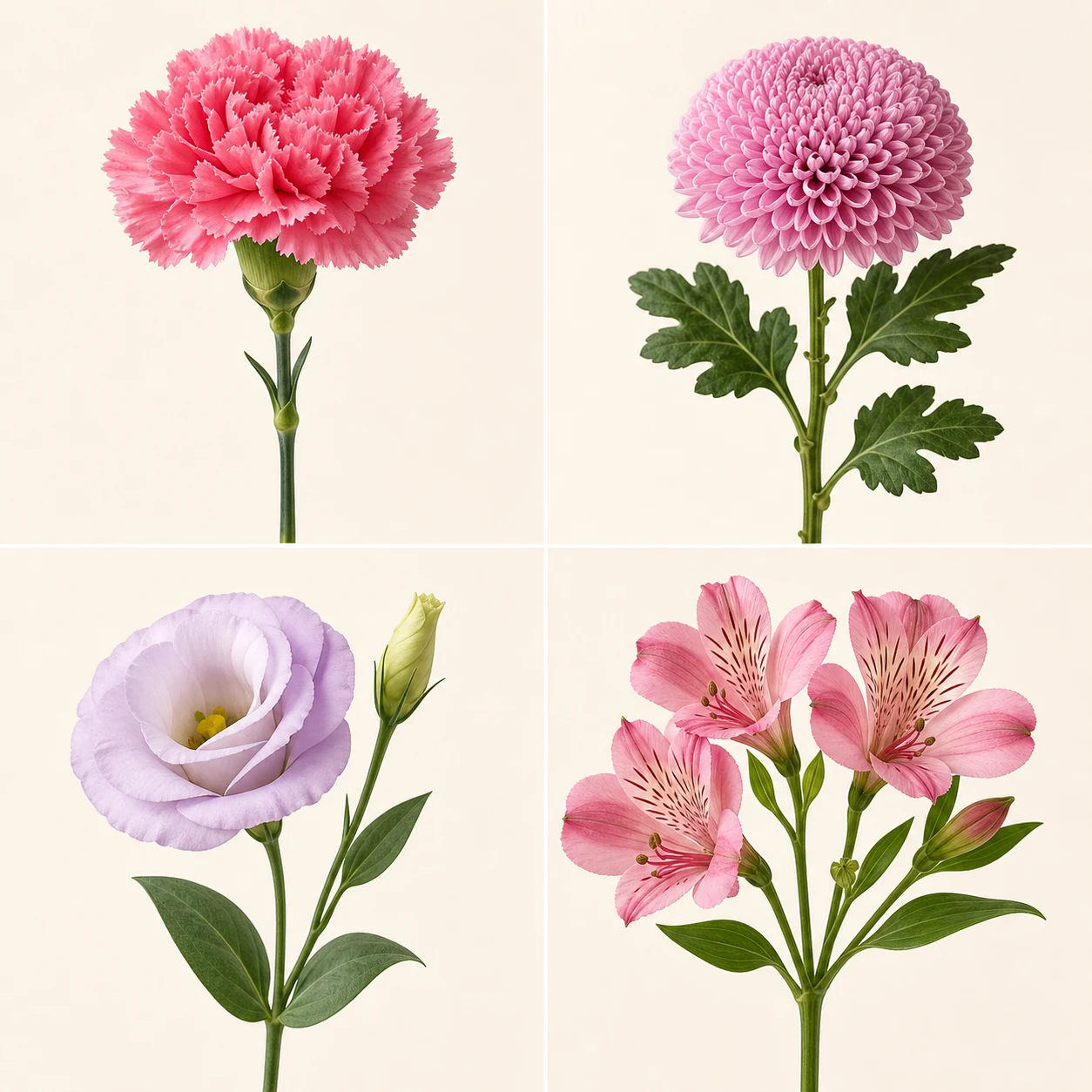
25. Carnation — the ruffled round
Carnations have densely frilled petals with serrated edges and a rounded head. Bouquet role: mass and durable detail. Clustered tightly, they create a velvety color surface; spaced loosely, each ruffle becomes visible.
26. Chrysanthemum — the great shape-shifter
Chrysanthemums may appear as daisy faces, buttons, cushions, spiders, or large disbud blooms. The composite flower head is the common thread. Bouquet role: almost anything—mass, texture, accent, or focal—depending on form. Name the type when precision matters.
27. Lisianthus — the soft bridge
Lisianthus combines rose-like cups with tapered buds on branching stems. Bouquet role: bridge flower. It slips between larger focals, repeats their softness at a smaller scale, and keeps the bouquet from jumping abruptly from bloom to filler.
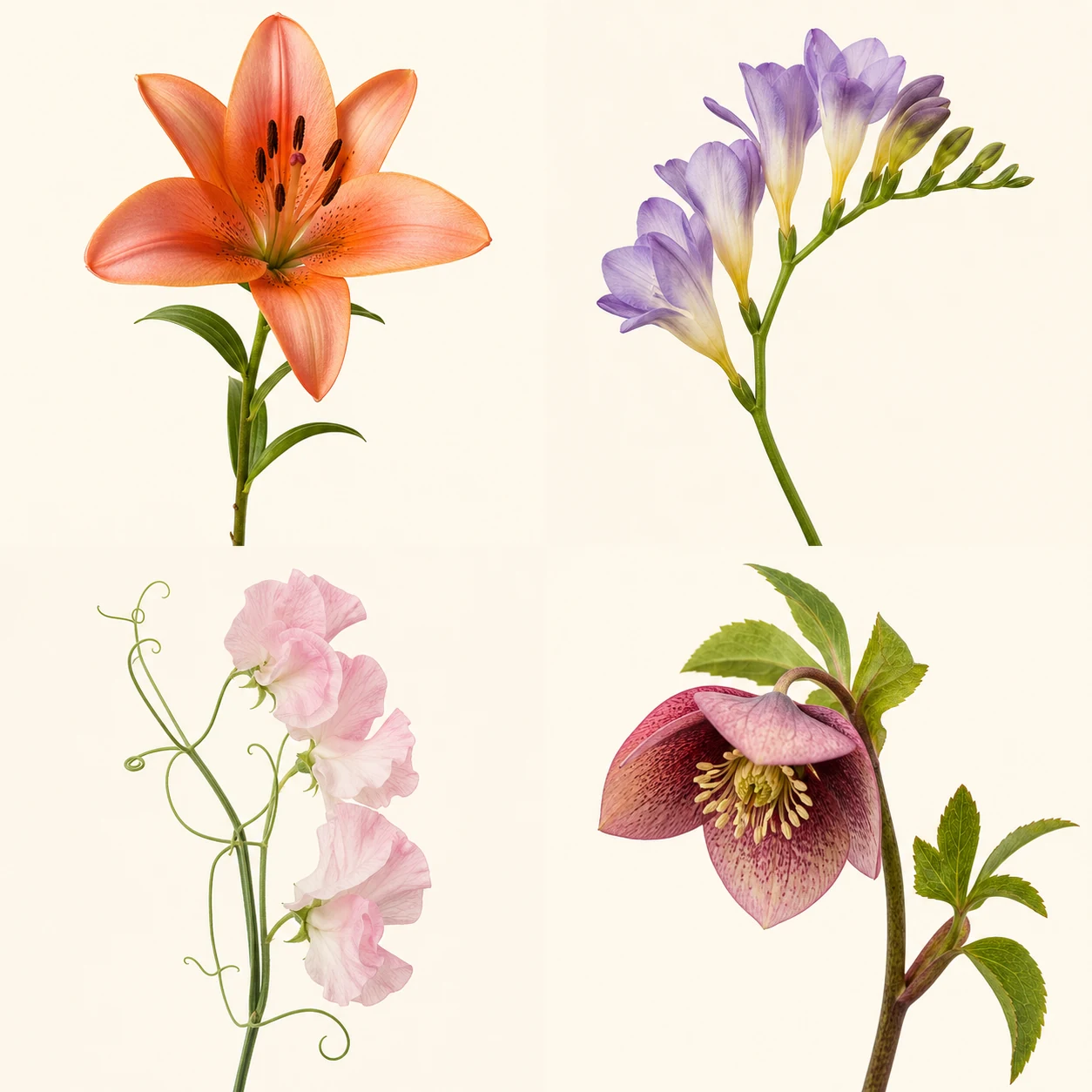
28. Alstroemeria — the clustered streaked lily
Several lilylike flowers open together near the top of each stem, and the inner petals often show fine stripes or freckles. Bouquet role: color bridge and mass. One stem distributes multiple faces through the design efficiently.
29. Asiatic lily — the six-part star
Asiatic lilies open into broad six-part stars with noticeable anthers, often carrying several buds and blooms on one stem. Bouquet role: large mass or focal. Their scale can connect a group of roses to tall line flowers without disappearing between them.
30. Freesia — the scented one-sided curve
Freesia sends fragrant funnel-shaped flowers along one side of a gently bent stem. Bouquet role: scented accent and small line. The unopened buds extend the gesture beyond the flowers already showing.
31. Sweet pea — the flutter
Sweet peas have thin winged petals, fine stems, and a light, ruffled appearance. Bouquet role: fluttering accent. They soften hard outlines and make a garden-style bouquet feel as if air is moving through it.
32. Hellebore — the nodding transition
Hellebore presents a downward- or outward-facing five-part bloom, often with a conspicuous ring of stamens and beautifully muted color. Bouquet role: moody transition flower. It links greens, dusty neutrals, and focal blooms without becoming ordinary filler.
Air, texture, and tropical punctuation
The final eight prove that bouquet importance is not measured only by bloom size. Some create atmosphere; others stop the eye with one extraordinary form.
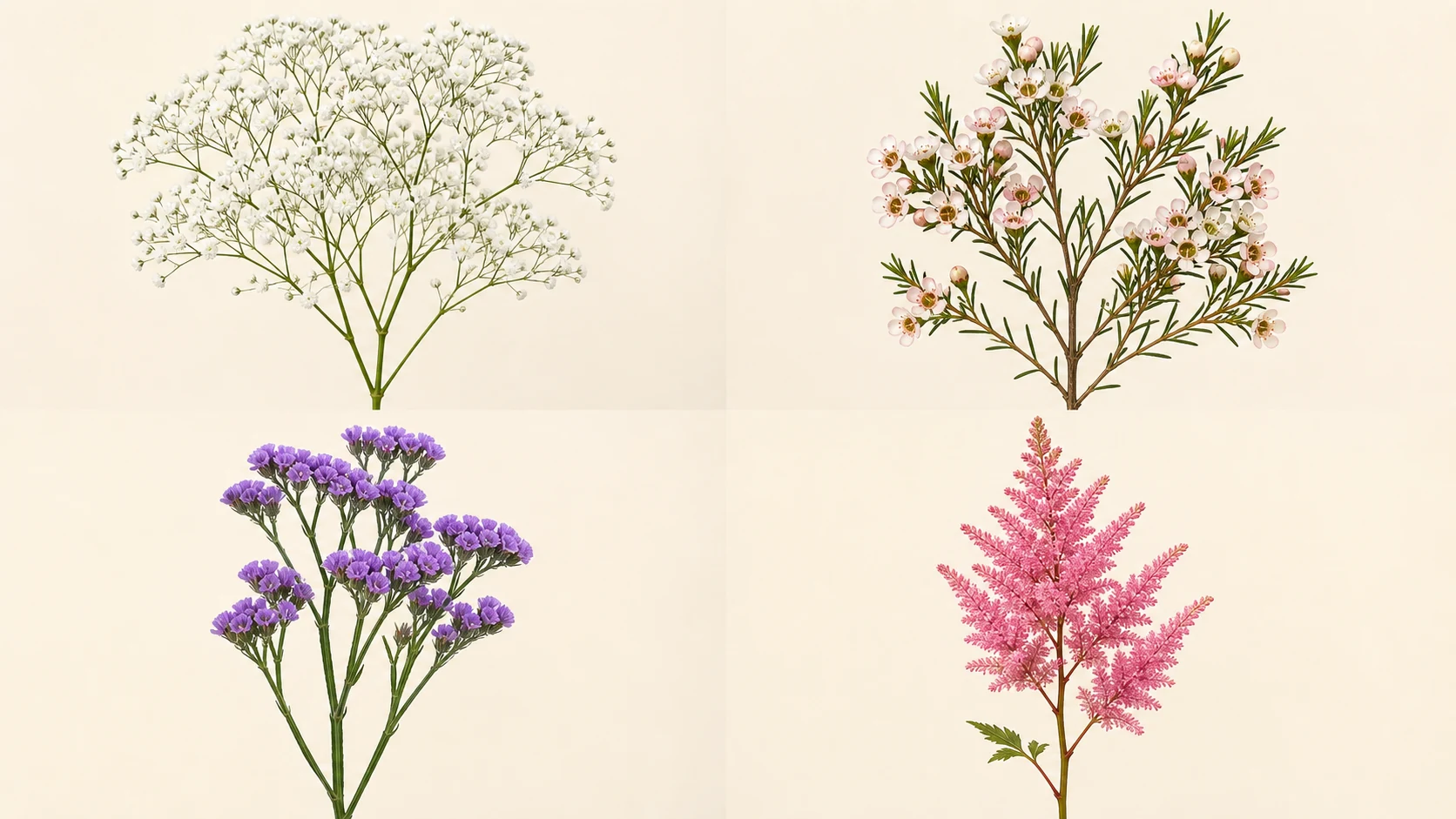
33. Baby’s breath — the veil
Hundreds of tiny white or blush blooms float on very fine branching stems. Bouquet role: veil and airy filler. Used lightly, it opens breathing room; used densely, it becomes a cloudlike mass with its own authority.
34. Waxflower — the tiny waxy star
Waxflower carries small five-petaled flowers and buds along woody branching stems, often with needlelike foliage. Bouquet role: fine filler and crisp texture. It adds detail without dissolving into visual mist.
35. Statice — the papery color haze
Statice forms branching sprays of tiny, papery florets that hold their shape visibly. Bouquet role: color haze and textural filler. It can connect separated focal blooms or create a deliberately dried, meadowlike note.
36. Astilbe — the feathered plume
Astilbe is a soft plume made from a multitude of tiny flowers. Bouquet role: movement and soft texture. It blurs a hard edge more elegantly than a round filler because the plume points and trails.
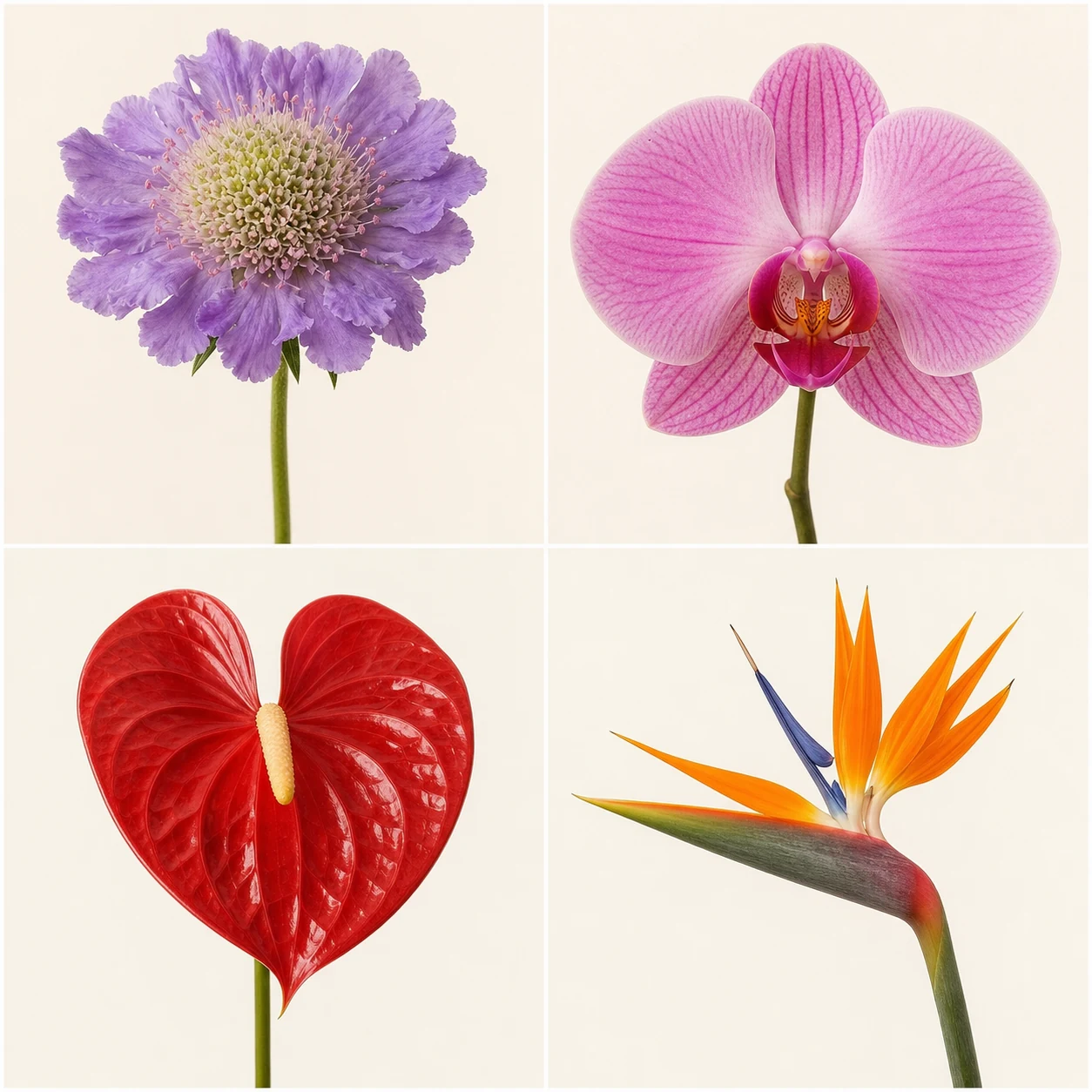
37. Scabiosa — the pincushion
Scabiosa shows a raised, pinlike center circled by a frilled outer ring. Bouquet role: small focal and textural bridge. It brings a memorable face without challenging the scale of a peony or dahlia.
38. Orchid — the floating asymmetry
Most bouquet orchids are easy to spot by bilateral symmetry and a distinctive central lip, though the family includes many different forms. Bouquet role: floating focal or form flower. A few blooms can create elegance through spacing rather than volume.
39. Anthurium — the glossy heart and spike
Anthurium pairs a smooth, often heart-shaped spathe with a protruding central spadix. Bouquet role: graphic form flower. It creates a modern flat plane among layered petals and is especially strong when the design needs one decisive visual stop.
40. Bird of paradise — the tropical crest
Orange and blue flower parts emerge like a crest from a rigid boat-shaped bract. Bouquet role: tropical line and form. It brings direction, height, and a recognizable destination mood in one stem.
Orchids create spaced accents around hydrangea, roses, and stock. Their blooms form distinct visual pauses instead of adding another dense layer.
How to choose among 40 without getting lost
Start with the job, not the flower name.
- Pick one visual anchor: perhaps rose, peony, dahlia, protea, or anthurium.
- Decide whether the bouquet needs height or a low silhouette.
- Add one bridge flower that repeats the palette at a smaller scale.
- Choose whether the negative space should feel clean, garden-loose, or cloudlike.
- Stop before every flower becomes equally important.
A bouquet becomes memorable through hierarchy. Hydrangea can create the room, a rose can hold the center, veronica can lift the edge, and waxflower can finish the sentence. Forty names are useful; four well-chosen roles are usually enough to build the design.
When you are ready to see those roles working together, choose a Rosa Fiora bouquet by flower, palette, or occasion. Look first for the shape that draws your eye—then read the flower names with a designer’s understanding of what each bloom is doing.