Standard, Spray or Garden Roses: Which Looks Best in a Bouquet?
See the difference between one clean rose head, a branching spray, and a layered garden rose—and choose the architecture your bouquet needs.
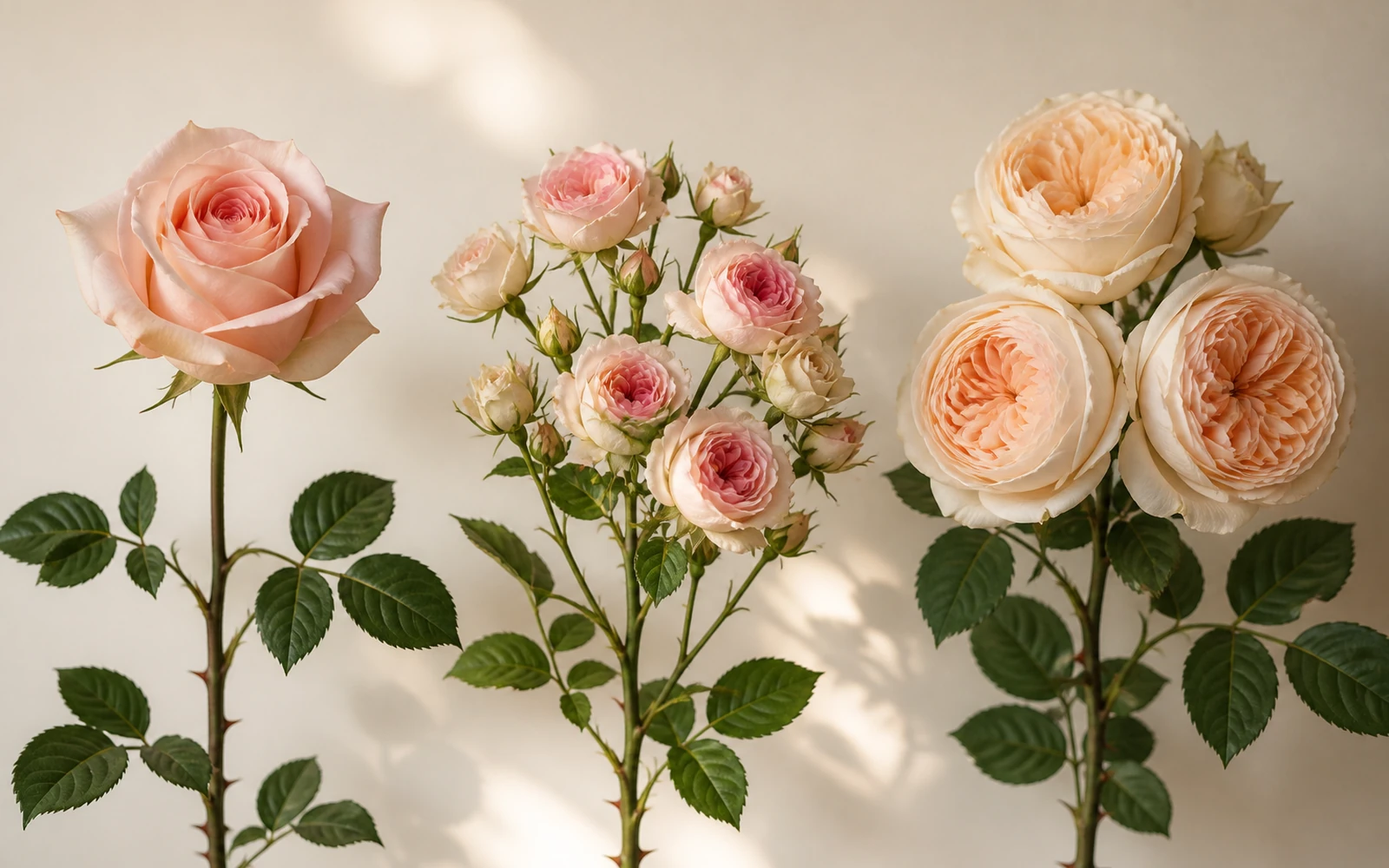
Choose standard roses for clean focal heads, spray roses for branching detail and fullness, and garden roses for open, layered texture. None wins every bouquet. The best choice is the one that creates the silhouette you want.
I look at the stem before I look at the label. One standard stem gives me one dominant bloom. One spray stem gives me several smaller bloom points. A garden rose may still be one flower on one stem, but that flower opens with a softer, more dimensional character.
The difference at a glance
| Rose type | What one stem contributes | Best visual effect | Watch for |
|---|---|---|---|
| Standard cut rose | One dominant flower head | Tailored rhythm, clear focal points, smooth rounded designs | Variety and opening stage change the final shape |
| Spray rose | A branch with several flowers and buds | Texture, distributed color, visible fullness | Never compare its stem count one-for-one with standard roses |
| Garden or garden-style rose | Usually one high-petal bloom that opens wider | Romantic focal texture, softness, layered movement | The exact form varies by cultivar |
This is a cut-flower comparison, not a guide to planting roses. Hybrid Tea, Floribunda, Shrub, Climbing, and Miniature are horticultural classes; standard, spray, and cut garden rose are the practical categories a bouquet buyer is more likely to meet.
Standard roses: the cleanest focal point
Individual standard-rose heads build a broad, tailored crown in cream, champagne, and dusty pink.
A standard cut rose is generally sold with one dominant bloom at the end of the stem. That makes it easy to place as a focal point and repeat through a bouquet.
Standard roses create clarity. Ten visible heads can form a controlled dome, a clean line, or a deliberate rhythm. They are especially strong when the bouquet should feel tailored rather than loose.
I choose them when I want:
- one readable bloom at each placement point;
- a smooth rounded surface;
- a classic rose silhouette;
- precise spacing between flowers;
- color repetition without branching texture.
“Standard” describes the cut-flower form used in the trade: one dominant bloom on each cut stem. Garden classification and bouquet quality are separate questions, so compare the visible flower form, opening stage, and condition of the actual stems.
Spray roses: texture built into the stem
Petite spray-rose blooms gather into a generous pink cloud with intricate detail across the whole bouquet.
A spray rose branches into several flowers and buds. One stem can show open blooms, half-open flowers, and tighter buds at the same time.
That branching shape carries color through more of the bouquet. It can soften the gap between larger focal flowers, create a cloud of small blooms, or become the main texture itself.
I choose spray roses when I want:
- fullness without a row of identical large heads;
- visible buds and opening stages;
- a garden-led or textural feeling;
- color repeated across a wider area;
- movement between focal flowers.
Do not compare spray and standard roses by stem count alone. One standard stem brings one dominant head; one spray stem distributes several bloom points. Equal stem numbers rarely create equal silhouettes.
Garden roses: the bloom that changes as it opens
Layered garden roses give a blush-and-ivory palette its generous, romantic character.
Commercial cut garden roses are chosen for high-petal blooms that open into a fuller, layered shape. Many are single-headed, so the difference from a standard rose is often in the flower itself rather than the branching structure.
A garden rose can expand noticeably after hydration. Its center may reveal more layers, and its outline can move from compact to open and expressive.
I choose garden roses when I want:
- one bloom to carry rich petal texture;
- a softer focal point;
- a romantic or editorial mood;
- visible change as the flower opens;
- fullness that comes from petal depth rather than a cluster of branches.
Garden roses are not one formal botanical class. “Garden-style” is the right phrase when the visual character is known but the cultivar classification is not.
Which rose looks best for your bouquet?
Choose standard when the bouquet should feel polished
Standard roses suit clean repetition, formal gifts, monochrome designs, and bouquets where every focal flower should read clearly. They can feel minimal or abundant depending on stem count and spacing.
Choose spray when the bouquet needs life between the focal flowers
Spray roses bring buds, small blooms, and branching movement. They are ideal when the arrangement should feel airy, textural, or naturally full.
Choose garden when the rose itself should be the drama
Garden roses reward a closer look. Their layered centers and opening form make them powerful in romantic bouquets, wedding work, and designs built around petal texture.
Combine them when you want depth
Some of the strongest rose bouquets use all three. Standard heads establish rhythm, spray roses connect the composition, and garden roses create the memorable focal moments.
Compare current rose bouquets and look for those three jobs rather than choosing by color alone.
Why substitutions can change more than the flower name
Replacing a standard rose with a spray keeps the general idea of “rose” but changes one focal point into a cluster. Replacing an open garden rose with a tighter standard cut can preserve the palette while removing layered texture.
When the architecture matters, protect it in the product choice:
- standard for standard when clean focal heads define the design;
- spray for spray when branching detail creates the fullness;
- garden-style for garden-style when the open petal character is the reason you chose the bouquet.
The American Rose Society and University of Illinois Extension explain why horticultural classes and trade language do not align perfectly. At the bouquet counter, focus on what each stem does when it joins the arrangement.
Read the bouquet like a florist
Look for one clear head, a branching cluster, or a bloom opening into layered texture. Once you see those three structures, the product photograph becomes far more useful.
Then decide what you want the bouquet to feel like: tailored, textural, romantic—or a deliberate combination of all three. Use rose color meanings only after the structure is right, and compare bouquet presentation formats when choosing between hand-tied and ready-to-display designs.