Small Wedding Bouquets: How to Make Every Detail Intentional
A smaller bouquet gains visual authority through deliberate proportion, flower scale, texture, silhouette, stem finish, and its relationship to attire.
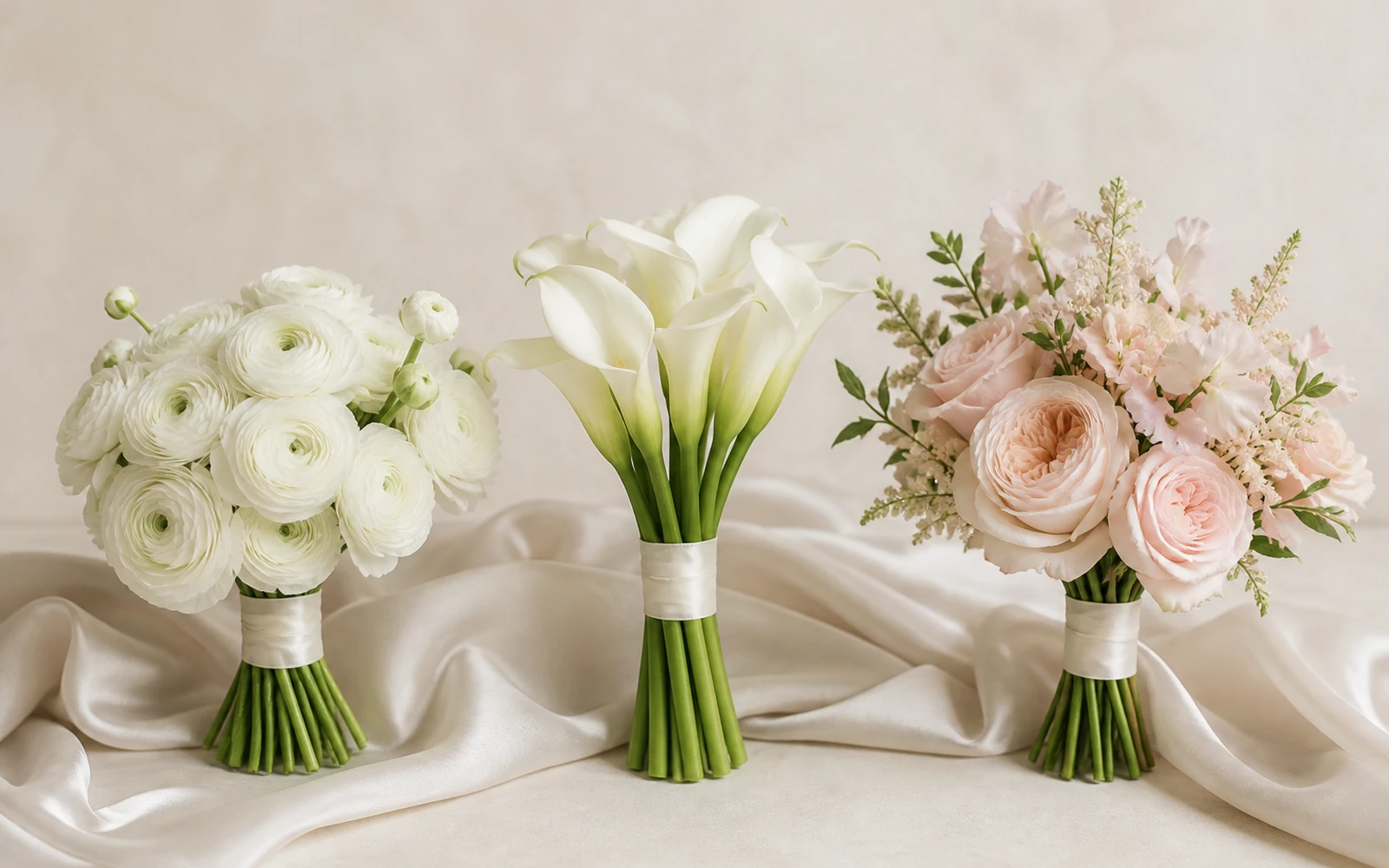
A small wedding bouquet looks intentional when proportion, flower-face scale, hierarchy, texture, silhouette, attire, and stem finish all point in the same direction. Compact scale brings every choice into close view. Give the eye one clear place to begin, edit the outer line, and finish the handle as carefully as the flower face.
Use this seven-part brief:
- Proportion: intended width, height, and depth against the hands and attire.
- Flower-face scale: broad focal faces, smaller rhythmic faces, or one slender linear form.
- Hierarchy: what the eye reads first, second, and last.
- Texture: one dominant surface and one contrast.
- Silhouette: centered, softly irregular, or linear.
- Attire relationship: the detail to frame, echo, contrast, or leave visible.
- Stem finish: exposed stem length, binding point, ribbon width, ribbon length, edge, and front.
Bring a full-length attire image, one waist-up image, the venue, and those seven decisions to start a wedding bouquet conversation with Rosa Fiora. The current Wedding bouquet collection can help you identify which compact visual strategy feels closest before the consultation.
Three ways a compact bouquet can command the frame
Small describes the measurement direction. Proportion, line, and finish give the bouquet its design identity. Here are three materially different ways to create one.
Concentrate the flower faces
A petite rounded cluster can gather the visual weight into a clean field. Layered white ranunculus create depth through their petal structure, while an exposed-stem handle and broad ivory ribbon give the lower edge a deliberate finish.
This direction works when the flower face should be read first. Keep the palette focused and let repetition create calm. The individual blooms remain visible up close, while the group becomes one clear shape from farther away.
Let the edge stay softly irregular
A compact ivory rose cluster can feel less formal when the edge rises and falls gently rather than closing into a strict dome. A warm neutral ribbon and visible stems complete the quiet, hand-tied character.
Here, authority comes from subtle variation. The palette is restrained, so stem height, opening stage, negative space, and ribbon finish carry more of the visual work.
Build one slender line
Ivory calla can create a narrow vertical sheaf with a gently flared top. Smooth flower forms, clean green stems, and a close ribbon-bound handle make line—not floral mass—the dominant read.
This is useful when a compact bouquet should feel graphic and directional. One repeated form can create a stronger statement than several unrelated accents competing inside a small footprint.
These cards are visual case studies. Use them to compare concentration, irregular softness, and linear focus; let the live cards carry their current product details.
Proportion begins with relationships
West Virginia University Extension’s floral design guide defines proportion through the relationship of size and shape among materials, and balance through physical and visual weight. For a bridal bouquet, that relationship includes the flower faces, stems, hands, attire, and empty space around the design.
I would set proportion with photographs rather than a generic diameter. Place a bouquet reference beside a full-length attire image and ask:
- Where should the bouquet begin and end across the waist?
- Which neckline, lapel, sleeve, embroidery, draping, or tailoring should remain visible?
- Should the floral line sit centered, move slightly outward, or rise vertically?
- How much of the hands and handle belongs in the finished look?
- Does the bouquet read clearly at full length as well as in a detail frame?
A small bridal bouquet can sit close to the body as a composed floral punctuation. It can also project one narrow line beyond the hands. Both are compact; their proportions create different expressions.
Avoid sizing the bouquet to a body category. Use the actual attire, intended hand position, camera framing, and venue route. Those are visible design inputs.
Choose flower-face scale before flower count
Flower-face scale controls rhythm. Broad roses, open ranunculus, hydrangea heads, anthurium, calla, orchids, and fine branching materials occupy space differently. A compact footprint makes those differences obvious.
Broad faces create calm mass
One or two broad flower families can establish the bouquet quickly. Repetition gives the eye a continuous field, while subtle opening stages or petal layers provide depth. This is a strong direction for ivory, blush, red, or another focused color story.
Smaller faces create rhythm
Smaller ranunculus, spray roses, sweet peas, or fine textural flowers can create many visible beats. Edit their colors and heights so the rhythm reads as intentional detail rather than scattered points.
Slender forms create line
Calla, tulips, and other directional forms can produce a compact bouquet through narrow width rather than rounded concentration. Align the stems and decide where the upper line opens, bends, or stays parallel.
Flower count is only one input. Compare the size, direction, spacing, and repetition of the visible faces; those relationships tell the florist how the bouquet should read.
Give the eye a first, second, and last read
Hierarchy is what gives a small arrangement authority. Decide the viewing order.
For example:
- First: a clean ivory flower field.
- Second: a softly uneven edge.
- Last: champagne ribbon and neat green stems.
Or:
- First: one slender white line.
- Second: the flare of smooth calla faces.
- Last: a close, quiet handle finish.
A compact bouquet loses clarity when every bloom becomes an accent. Choose one dominant color, form, line, or texture. Then use contrast in a smaller role: one glossy surface inside a matte field, one fine branch beside broad petals, or one fresh green note inside ivory.
This approach also makes “simple wedding bouquet” a useful brief. Simple means the hierarchy is easy to read. The editing can be exacting even when the final image feels effortless.
Edit texture at close range
Texture becomes especially visible in waist-up portraits, ring photographs, and hand-held detail frames. Name the dominant surface first:
- layered and ruffled;
- smooth and sculptural;
- soft and matte;
- glossy and tropical;
- fine and branching;
- crisp and tailored.
Then choose one contrast. Smooth calla beside a narrow ribbon edge. Layered ranunculus above straight green stems. Soft roses with one glossy leaf. Fine branching texture beside a broad focal face.
One contrast gives the eye a reason to linger. Several equal contrasts fracture the small composition. When reviewing a reference, circle the texture that defines it and cross out the supporting material that adds no new line, color, or surface.
For a broader method that begins with emotion, palette, season, and venue, use the wedding bouquet ideas framework. Bring only the final texture priority back into this compact edit.
Make the silhouette legible from across the room
Before looking at individual flowers, reduce the bouquet to its outer edge. A small silhouette can be:
- centered: one contained visual field around the hands;
- softly irregular: a compact center with measured changes in height;
- linear: a narrow vertical or diagonal gesture.
Photograph the reference small on the screen or step back from it. If the outline disappears, identify what is competing: too many fine extensions, an unclear hand position, several equal directions, or ribbon movement that belongs to another composition.
Named bouquet styles and their different carrying behaviors are covered in 11 types of wedding bouquets. Here, stay with the outer-line decision. The goal is a compact silhouette that can be recognized before the viewer studies the petals.
Let attire choose what stays visible
The bouquet and attire occupy the same frame. Use a full-length image first, then zoom in.
For lace, beadwork, embroidery, print, or dramatic tailoring, mark the details that should remain visible. The bouquet can echo one motif through repeated flower faces, contrast the surface through a cleaner form, or sit slightly away from the focal detail.
For a minimal dress, suit, jumpsuit, or tailored set, decide whether the flowers should continue the clean line or introduce one deliberate softness. A compact cluster can create a centered floral note. A narrow sheaf can extend the tailoring vertically. A softly irregular edge can bring movement without broad coverage.
Choose bouquet size from the exact relationship you want among flowers, hands, attire, and the full look.
Finish the stems as part of the design
At compact scale, the handle occupies a meaningful share of the composition. Write the finish into the brief:
- how much green stem remains visible;
- where the binding point sits;
- whether the stem ends align or vary;
- ribbon color, width, texture, and edge;
- close wrap, short tails, or longer movement;
- the front orientation when held.
A broad ribbon can visually anchor a rounded cluster. A narrow close wrap can keep a linear bouquet clean. Short tails can maintain an edited outline; longer tails can introduce a separate moving line. Choose the relationship deliberately.
Then hold a similar-size object at the intended position during an attire fitting or photo test. Look at the front, three-quarter view, and side. Adjust the hand position and visible handle before finalizing the brief.
Use the five-view proof
Review the bouquet from five distances. Each one reveals a different edit.
| View | What should read | Final edit |
|---|---|---|
| Across the room | one silhouette and color direction | remove competing extensions or color notes |
| Full length | intended space against attire | adjust width, height, direction, and hand position |
| Waist up | clear hierarchy near neckline, lapel, sleeve, and waist | refine focal placement and visible detail |
| Close detail | purposeful flower faces, texture, and spacing | remove repetitive material and sharpen contrast |
| In the hands | binding, stems, ribbon, orientation, and movement | complete the handle and carrying direction |
This test gives a small bouquet several chances to speak. It can be quiet across the room, exact at waist height, and richly detailed in the hands while keeping one coherent identity.
Miami changes the handoff and portrait sequence
A compact bouquet moves easily through many settings, yet the plan still needs real locations and contacts. A Miami wedding may begin at a condominium, hotel, courthouse, private home, or waterfront venue, with portraits in another indoor or outdoor location.
Add these details to the design brief:
- property name and complete address;
- concierge, security, loading, elevator, or venue contact;
- preparation room and first handoff;
- indoor and outdoor portrait sequence;
- water and holding location between scheduled moments;
- the person assigned to the bouquet when both hands are needed.
Use Rosa Fiora’s current Delivery Policy for the property and access information attached to the request. The local layer changes the route: a slender vertical bouquet may need a clear orientation through a car and elevator, while longer ribbon movement may enter only for a chosen portrait setting.
Make the final edit
Complete these lines before the consultation:
Attach full-length and waist-up attire images, one close texture reference, one silhouette reference, and the Miami route details. That compact brief gives every visible element a role.