How Long Do Flowers Last? A Flower-by-Flower Vase-Life Timeline
Some flowers naturally last longer than others. This guide compares likely vase life without promising an exact number of days.
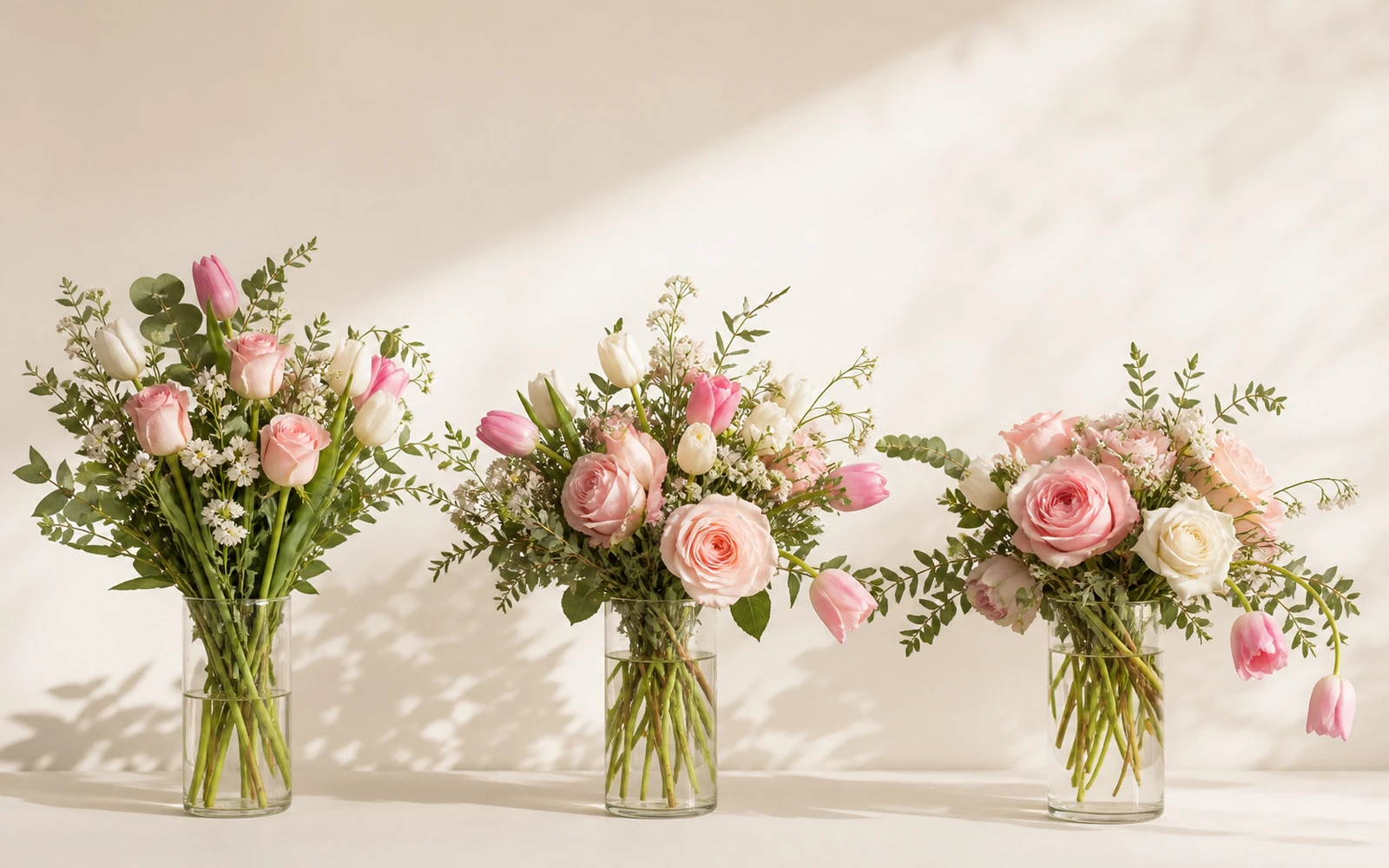
A Mississippi State University floristry manual uses about seven days as a general consumer expectation for many delivered arrangements. The useful flower-by-flower answer is wider: peonies may give you 5–7 days, roses 7–10, carnations 7–14, and chrysanthemums or cut orchids can reach 14–21. In a mixed bouquet, the flowers will usually finish on different days.
The vase-life timeline
| Flower | Planning range after receipt | What I watch for |
|---|---|---|
| Peonies | 5–7 days | Softening edges and petals beginning to release |
| Ranunculus | 5–8 days | A weakening neck, translucent petals, or petal drop |
| Tulips | 5–10 days | Soft tissue or collapsing petals; curving stems alone are normal |
| Roses | 7–10 days | Bent neck, persistent wilting, brown spotting, or heavy petal drop |
| Hydrangeas | 5–10 days | Sudden collapse or crisp brown tissue |
| Lilies | 7–14 days | Individual florets finish in sequence; leaves may yellow |
| Gerberas | 7–14 days | A bending neck, an aging center, or curling petals |
| Alstroemeria | 7–14 days | Yellowing leaves or dropping petals |
| Carnations | 7–14 days | Browning or curling petals and softening at the calyx or stem |
| Chrysanthemums | 14–21 days | Yellowing leaves, wilting, or browning florets |
| Cut orchids | 14–21 days | Translucent, spotted, or dropping blooms |
These are planning windows, not expiration dates. They begin when the bouquet reaches the recipient, not when the flower was cut. Variety, maturity, time already spent in the supply chain, temperature, hydration, and care can move a stem outside the range. University of Illinois Extension likewise separates shorter-lived roses from carnations that may remain vibrant for one to two weeks.
Roses, hydrangea, and orchids gather in a softly rounded wrapped bouquet. That combination makes staggered aging easy to understand: the arrangement can remain beautiful after one flower type is ready to come out.
Why a mixed bouquet does not have one finish date
I judge a bouquet stem by stem. A rose may be fully open while the orchid beside it still looks nearly unchanged. A hydrangea can collapse quickly while carnations continue holding their shape. Waiting for every flower to look tired at once means leaving finished material in the vase too long.
Edit the arrangement as it ages:
- Remove the individual stem or floret that has finished.
- Check the water for cloudiness, odor, or debris.
- Recut sound stems when you refresh the vase solution.
- Recompose what remains instead of treating the smaller bouquet as a failure.
This is the beauty of a mixed arrangement: it changes. A generous design can become a tighter bedside bouquet, then a few excellent stems in a bud vase.
Flowers that move, open, and change before they finish
Some normal flower behavior looks dramatic enough to be mistaken for decline.
Tulips keep moving
Tulip stems often elongate and curve in the vase. Their line can change from upright to loose and expressive while the petals remain firm. I retire a tulip when the stem tissue becomes soft or the bloom collapses—not simply because it leaned toward the light.
Tulips put that movement at the center of the design. If you love a bouquet that changes its silhouette day by day, their shifting line is part of the pleasure.
Lilies open one floret at a time
A lily stem is a sequence, not a single event. One floret can finish while the next bud is opening. Remove the spent floret and let the rest of the stem continue.
Roses relax as they open
A rose does not need to stay tight to stay fresh. UC Davis postharvest guidance gives properly handled commercial roses a credible benchmark of about 10 days. Opening petals, a visible center, and a softer silhouette can be beautiful; bent neck, persistent wilting, brown blotches, fuzzy gray growth, or tissue that is breaking down tell a different story. For the full rose-specific routine, use the nine mistakes that shorten rose life.
What can move a flower outside the range
The flower name sets the starting expectation. Condition and environment decide how the performance unfolds.
Variety and maturity
Two cultivars from the same flower family may not keep for the same length of time. A bloom delivered tightly closed also behaves differently from one already near full opening. That is why I use a range instead of assigning one exact day to “roses” or “tulips.”
Handling before the bouquet reaches you
Vase life starts long before the vase. Hydration, sanitation, temperature, transport, and the flower’s condition at each stage affect what remains when it arrives. A recipient can care for flowers beautifully and still be working with a timeline shaped earlier in the supply chain.
The room
Direct sun, heat-producing appliances, hot window glass, and strong drafts work against longevity. A cooler, stable indoor position gives the bouquet a better setting. In a Miami home, pay particular attention to a table beside sun-heated glass; strong air-conditioning elsewhere in the room does not cool that hot pocket.
Water and sanitation
Cloudy water and vase residue interfere with the clean hydration cut flowers need. Use a thoroughly washed vase, keep foliage above the waterline, and use the supplied flower food at its stated dilution. The complete fresh-flower care guide owns the daily routine; the timeline here tells you what that care is realistically supporting.
Fresh, changing, or finished?
I use three stages instead of asking whether the entire bouquet is “alive” or “dead.”
Fresh: Stems are firm, petals hold their structure, the water is clear, and buds or florets are opening as expected.
Changing: Roses open, tulips curve, lily florets finish one by one, and the arrangement becomes looser. Edit it, turn the vase, and enjoy the new silhouette.
Finished: A stem remains wilted after the water and cut are corrected; tissue turns soft, translucent, crisp brown, or foul-smelling; petals drop heavily; or fuzzy growth and spreading brown spots appear. Remove that material from the arrangement.
The table gives you a calendar. The flower gives you the final answer.
When the final stems have finished, the flower-drying guide compares five preservation paths by shape, color, difficulty, and keepsake use. If you are choosing your next arrangement, browse Rosa Fiora bouquets by the flowers and style you want to live with—then expect the bouquet to evolve through each stage.