Beach Wedding Flowers: Plan for Wind, Heat and Salt Air
Build beach wedding bouquets and ceremony flowers around the coastal route, exposure, setup, silhouette, holding plan, and visual result you want to protect.
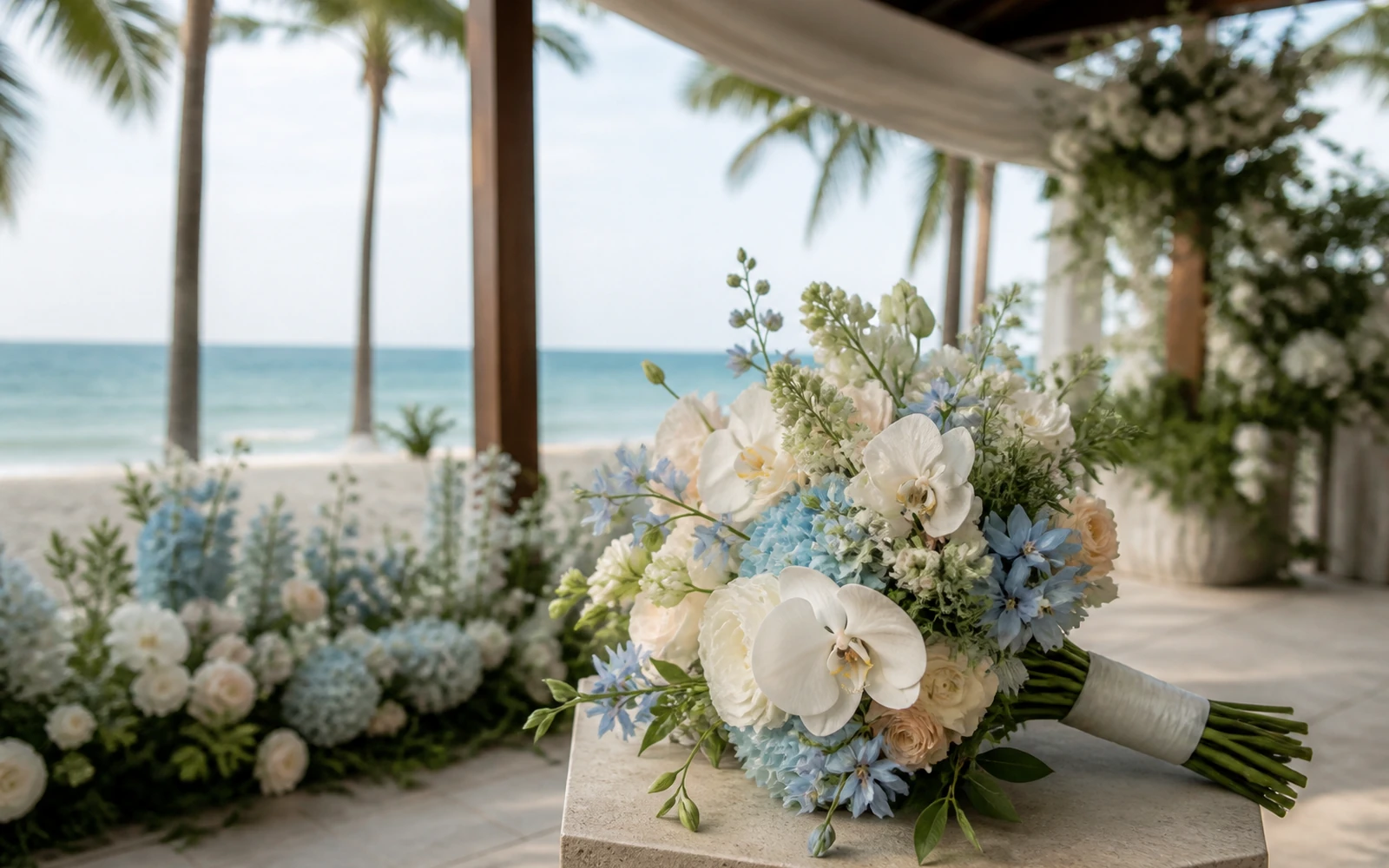
Beach wedding flowers need a coastal plan built around wind, heat, direct sun, salt air, transport, ceremony setup, exposure time, and a real holding location. Start with the route and timeline, then shape the bouquet and installations around the most exposed moments. Ask what each piece will experience and which design or setup decision follows.
Bring these seven lines to the first floral conversation:
- Setting: open beach, waterfront terrace, dune edge, covered deck, or indoor room with outdoor portraits.
- Route: vehicle, loading point, elevator or boardwalk, holding room, ceremony, portraits, and reception.
- Exposure: where wind, direct sun, heat, and salt air enter the sequence.
- Timing: when each floral piece leaves holding, enters the ceremony space, and moves again.
- Silhouette: compact, directional, trailing, upright, or open—and which movement matters most.
- Setup: the floral focal points, their order of installation, and the venue contact for each area.
- Holding: the exact cool space, water point, work surface, and person responsible for the next handoff.
If your venue and schedule are taking shape, send Rosa Fiora your coastal wedding brief with those seven lines, an attire image, ceremony orientation, and two or three annotated references. You can also review the current Wedding bouquet collection to identify the silhouette and movement you want to discuss.
Turn every coastal condition into a decision
A coastal condition becomes useful when it changes the brief. I would put this table beside the floor plan and ceremony timeline.
| Coastal input | Design decision | Handling or setup decision |
|---|---|---|
| Wind | edit the outer line; choose the essential extensions; decide ribbon length and front orientation | review freestanding pieces, ceremony orientation, and staging order with the floral and venue teams |
| Heat | name the colors, shapes, and textures that matter most during the outdoor portion | identify the cool holding space, water point, and shortest practical staging interval |
| Direct sun | map which bouquets and installations sit in full sun, partial shade, or interior light | install the most exposed pieces closest to the moment they are needed |
| Salt air or direct spray | review exposed ribbons, vessels, decorative surfaces, and placement near open surf | identify protected staging and the route for setup materials and cleanup |
| Transport | choose silhouettes with the required clearance and orientation | map every door, elevator, stair, boardwalk, vehicle transfer, and handoff |
| Ceremony setup | concentrate the floral attention where the site and photographs need it | give every focal piece a position, setup order, and venue contact |
| Exposure time | assign each piece a first outdoor moment and next transition | put an owner beside every movement on the timeline |
| Holding plan | define what stays upright, hydrated, shaded, and undisturbed | name the exact location, access contact, water source, and work surface |
This is the heart of beach wedding flower planning: coastal conditions shape line, placement, timing, and movement from the beginning.
Coastal design traits to discuss with your florist
Use these traits as a fast creative brief:
- a controlled outer line with fewer fragile extensions;
- deliberate ribbon length and a clear front orientation;
- strong flower faces or sculptural forms that read from the intended camera distance;
- modular ceremony pieces with a named setup order;
- a defined cool holding location, water point, and handoff owner.
Calla, anthurium, orchids, and roses can be useful flower categories to discuss because they offer distinct faces, lines, and silhouettes. The final choice belongs to the wedding date, cultivar, opening stage, design mechanics, exposure map, and full venue route.
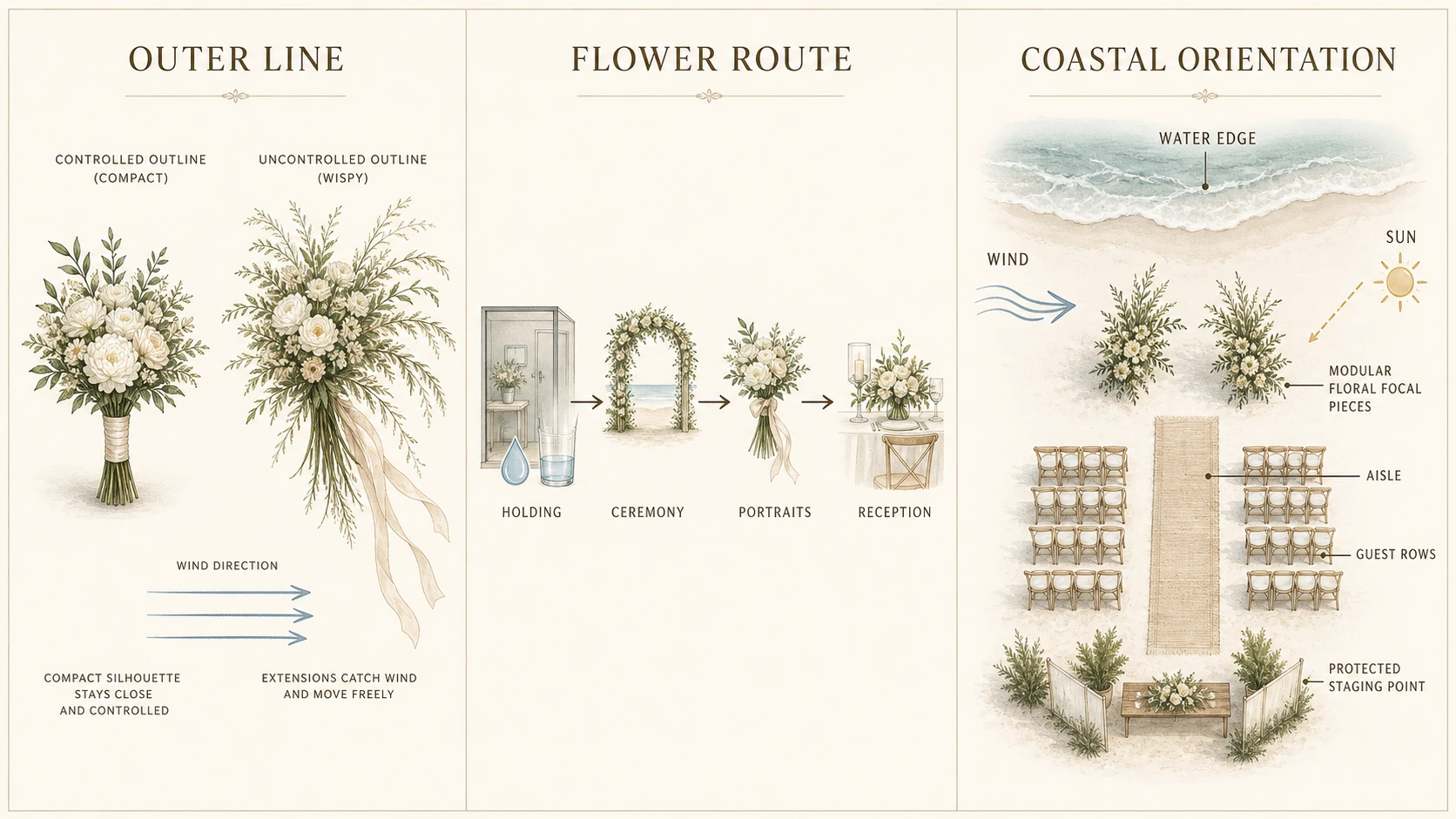
Wind starts with the outer line
Wind is first a silhouette conversation. Long grass-like extensions, open lateral reach, trailing ribbon, loose foliage, and a deep cascade all create visible movement. Decide which movement carries the design and which details can be edited.
A compact bouquet can still feel expressive through color contrast, flower-face scale, and a softly irregular edge. A directional bouquet can keep one strong reach instead of many competing wisps. A trailing design can reserve its length for a protected portrait setting or an indoor part of the celebration. These are creative choices tied to the actual route.
This asymmetric purple composition shows how smooth calla, rounded allium, layered flowers, and upright stock create direction without relying on a cloud of fine extensions. Use the card as a silhouette reference for the consultation.
An elongated blush-and-ivory cascade creates a completely different route question: where its lowest line sits against the attire, how it clears the vehicle and boardwalk, and when the long ribbon enters the photographs.
Neither example is a coastal formula. One helps you discuss edited direction; the other helps you map length, clearance, and transitions. That distinction is more useful than sorting flowers into generic beach lists.
For ceremony flowers, mark the direction guests face, the open-water side, the aisle, and the edges most exposed to moving air. Then decide where floral mass should sit and where a cleaner line will serve the setting better. Freestanding pieces, vessels, frames, and attached elements belong in the same venue-and-florist review as the floor plan.
Heat and sun belong on the clock
Cut-flower handling centers on cool conditions and freedom from water stress, as summarized by NC State Extension’s postharvest guidance. Translate that principle into five event questions:
- Where is the cool holding location before setup?
- Where can bouquets return to water between scheduled moments?
- Which pieces move outdoors first, and which can move later?
- When do the ceremony, family photographs, couple portraits, and reception transition begin?
- Who carries personal flowers back to the holding point?
Direct sun needs its own line on the site plan. A ceremony arch may sit in sun while the personal flowers remain indoors. An aisle piece may enter shade as the sun moves. Portraits may happen in an exposed waterfront area after the ceremony. Label those moments separately.
I would protect the visual result by naming priorities. If the bouquet’s identity comes from a broad ivory flower face, one clean vertical line, and a narrow green accent, write exactly that. Then let the handling and setup plan support those priorities through the outdoor sequence.
The wedding bouquet ideas guide helps turn color, texture, form, attire, and venue references into a complete design brief. Carry its visual decisions into this coastal timeline.
Salt air is a placement question
“Near the water” is too broad for a working brief. A ceremony several levels above the beach, a terrace behind glass, a lawn beside the bay, and a setup directly beside open surf create different placement and access conversations.
During the site walk, identify:
- distance and orientation to open water;
- areas where direct spray reaches surfaces;
- covered or protected staging space;
- exposed ribbons, vessels, mirrored pieces, and decorative finishes;
- the route for mechanics, water, packaging, and cleanup;
- the room or area where bouquets wait before the ceremony.
Salt air also sharpens the difference between a tropical look and an environmental plan. Anthurium, calla, orchids, palms, saturated coral, glossy green, and sculptural line can create a tropical visual language. Placement, exposure, setup, and holding complete the coastal brief alongside the flower direction.
Walk the flowers through the whole route
A beach wedding route often contains more transitions than the ceremony photograph reveals. Walk it in order with the florist or venue plan.
1. Vehicle to property
Record the loading entrance, contact, parking or loading instructions, elevator, stairs, doorway dimensions, and distance to the holding location. For a Miami hotel, condominium, resort, or managed venue, attach the access details requested through Rosa Fiora’s current Delivery Policy.
2. Holding room to ceremony
Name the water point, work surface, and person who opens the route. Decide which pieces travel together and which move separately. Put the bouquets, ceremony focal pieces, aisle flowers, and personal flowers in a clear sequence.
3. Ceremony to portraits
Write the portrait locations and their order. If photographs move from beach to lobby to terrace, identify who carries each bouquet between scenes and where water is available between scheduled uses.
4. Portraits to reception
List pieces moving indoors and the person directing that transition. The broader wedding flower checklist can assign every bouquet, personal flower, ceremony piece, and reception arrangement to a place, time, and owner.
5. Reception to final handoff
Record where personal flowers go after their last planned photograph and who receives any pieces leaving the venue. A named final handoff keeps the plan complete through the last transition.
Miami beach weddings need a live site conversation
Miami and South Florida coastal venues can combine air-conditioned interiors, sunny terraces, open-water edges, boardwalks, elevators, service corridors, and changing portrait locations in one event. That changes the bouquet route and installation order.
Close to the date, review the National Weather Service Miami beach forecast and the hourly point forecast opened for the venue from the NWS Miami forecast map. The beach page provides broader coastal conditions and hazards; the point forecast adds the venue’s hourly weather sequence. Review both alongside the venue’s current site information, then confirm which spaces are active, where staging occurs, how pieces move, and which design priorities belong in each setting.
Bring this local packet:
- ceremony and reception addresses plus on-site contacts;
- site photographs taken near the planned ceremony time;
- indoor and outdoor setup windows;
- service entrance, elevator, stair, and boardwalk route;
- holding room and water point;
- ceremony orientation and portrait sequence;
- the first and final handoff owner for every personal flower.
Miami relevance should change the plan. Here it determines access, holding, setup sequence, exposure mapping, and the movement between cooled interiors and waterfront spaces.
Write the coastal brief in one paragraph
Combine the creative and operational decisions before the consultation:
Attach a full-length attire image, floor plan, ceremony orientation, route photographs, setup and portrait times, holding location, and contact list. Add three annotated floral references that identify the color, texture, silhouette, and movement you want to protect. Use the wedding flowers by season guide to separate the seasonal visual direction from the coastal route and exposure plan.
That gives the florist a beach wedding plan with visible priorities, a real route, and flower choices connected to the coast.