How to Revive Hydrangeas: Emergency Steps to Try Before You Give Up
Cut hydrangeas can wilt dramatically. Diagnose the cause, reset the stem and vase, use a 30-minute head soak when appropriate, and know when to remove the bloom.
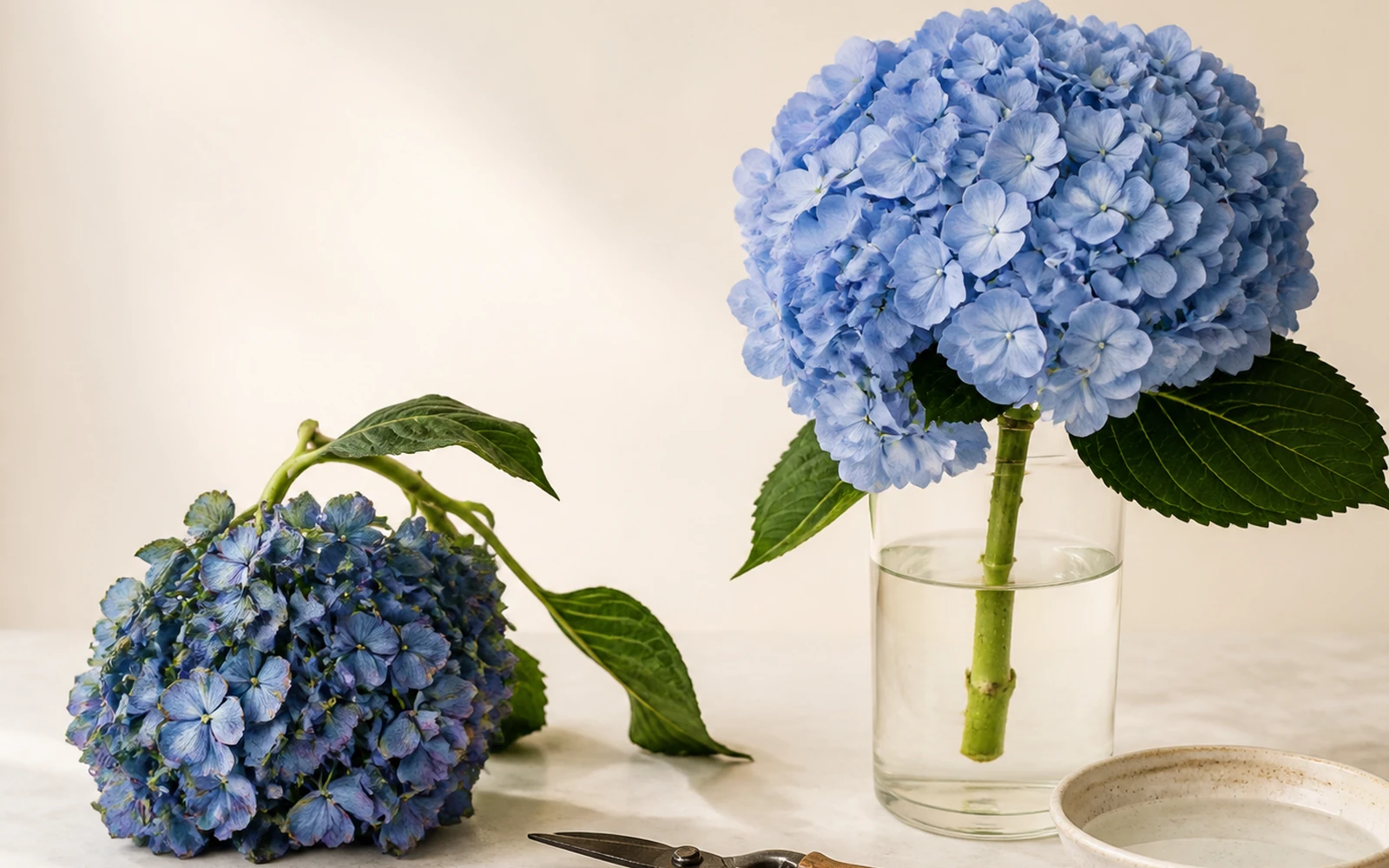
To revive a wilted hydrangea, remove that stem from the bouquet, check for decay, wash the vase, prepare fresh water with commercial flower food, trim the stem with a clean sharp tool, and remove foliage that would sit underwater. When the stem is firm and the florets are soft rather than brown or mushy, give the whole flower head one 30-minute soak in tepid water, then return the stem to the vase in a cool place.
Do these eight things in order:
- Isolate the wilted hydrangea.
- Decide whether it looks dehydrated or decayed.
- Wash the vase and replace compromised water.
- Mix fresh flower food exactly as directed.
- Remove submerged foliage and recut the stem.
- Soak a fresh, soft-wilted flower head in tepid water for 30 minutes.
- Return it to solution in a cool, quiet place.
- Reassess once after several hours and again the next morning.
This routine is for fresh dehydration. If the stem is slimy or collapsing, the water smells foul, or the florets are brown and mushy, remove that stem from the arrangement.
First, read the symptoms
Hydrangeas are wonderfully theatrical flowers. Their broad, cloudlike heads can collapse so completely that a water-balance problem looks like the end. I check the texture and smell before I judge the silhouette.
| What you see | What it suggests | What to do |
|---|---|---|
| Whole head droops; color is still reasonably clear; florets feel soft; stem is firm | Dehydration or impaired uptake may still be reversible | Run the full rehydration routine |
| Vase water is low, cloudy, or smells stale; leaves sit below the waterline | The solution needs immediate correction | Wash, refill, remove submerged leaves, and recut |
| Stem base is dark, slimy, soft, or foul-smelling | Decay is advancing from the base | Cut above it only if a firm clean section remains; otherwise discard the stem |
| Florets are broadly brown, translucent, mushy, crisp, or shedding | Damage or natural aging is advanced | Remove the hydrangea from the arrangement |
| Stem remains collapsed after a full night in clean solution and looks worse | Recovery is unlikely | Stop escalating treatments and retire the stem |
The distinction matters: dehydration is a water deficit that may reverse; decay is tissue breakdown that will not be repaired by adding more water. A hydrangea can also be senescing—finishing its natural vase life—without obvious rot. That flower may simply stay soft and tired after correct hydration.
If you love the rounded mass of hydrangea but the stem in front of you has finished, explore current hydrangea bouquets. These two designs show how differently the flower can carry a bouquet: as one clean cloud or as a softer blue garden blend.
Pale pink hydrangea builds the broad silhouette while deeper blush roses add smaller points of contrast.
Powder-blue and pink hydrangea provides broad structure around orchids, peonies, roses, and slender stock accents.
The hydrangea emergency routine
1. Take the collapsed stem out of the bouquet
Work on one hydrangea at a time. This lets you inspect the stem base and keeps compromised water or plant tissue away from the rest of the arrangement.
Look down the full stem. If only the old cut end is discolored but the section above it is firm and clean, there may be useful stem left to recut. If softness, slime, or dark collapse travels well upward, I would remove the stem rather than keep shortening it into damaged tissue.
2. Reset the vase, not just the flower
Give the fresh cut a clean solution. Iowa State University Extension recommends cleaning reused containers, removing foliage below the waterline, making a fresh cut with a non-crushing tool, and replacing water when it becomes cloudy or develops an odor in its cut-flower care guidance.
Wash the vase with hot, soapy water and rinse it well. Prepare fresh water with the commercial flower food supplied with the bouquet, following the packet ratio exactly. More concentrate is not more care.
If the rest of a mixed arrangement still looks good, reset that bouquet in a second clean vessel while the hydrangea has its own rehydration space.
3. Keep foliage out of the water
Strip every leaf that would fall below the waterline and remove yellowing or damaged leaves. Retain healthy upper foliage while the stem rehydrates.
Hydrangea heads have a substantial transpiring surface. A peer-reviewed study in The Horticulture Journal found a meaningful relationship between inflorescence transpiration and vase life in the tested cut hydrangeas; larger heads in that study showed higher water loss and shorter vase life than smaller ones (Kitamura and Ueno, 2015). The practical response is to protect water quality and keep the bloom away from conditions that accelerate water loss.
4. Make one clean, useful cut
Use clean, sharp clippers or a knife that will not crush the stem. Remove the old base and cut back to firm, clean tissue. Place the stem into the fresh solution promptly.
Skip hammering, burning, boiling, and repeated splitting. Those dramatic methods create more damage and distract from the essentials: a sound stem, a clean cut, clean solution, and lower water loss.
5. Give a soft-wilted flower head one tepid-water soak
Chicago Botanic Garden recommends submerging the whole hydrangea flower in a bucket of tepid water for about 30 minutes when a fresh bloom wilts (Chicago Botanic Garden). This is the hydrangea-specific step I use after the vase, solution, foliage, and stem have been reset.
Use it once when the stem is firm and clean and the florets are soft and drooping. Skip the soak when the stem is slimy, the flower smells foul, or the tissue is brown, translucent, or mushy; those signs call for removing the stem.
After 30 minutes, lift the flower gently, let excess water drain, and return the recut stem to the fresh vase solution.
6. Give it cool, still recovery time
Place the vase away from direct sun, hot windows, heaters, air-conditioning blasts, and strong drafts. A cool interior location gives the stem the best practical chance to restore its water balance.
Then leave it alone. Repeatedly lifting, cutting, changing treatments, and handling the flower head makes it impossible to tell whether the first correct intervention is working.
Hydrangea-specific postharvest research identifies water balance and solution management as central vase-life factors, while tested preservative combinations perform differently under controlled conditions (Kim et al., 2021). At home, use the commercial flower-food packet as directed and leave research formulations and household additive recipes out of the vase.
7. Watch for lift
After several hours, a responding hydrangea may begin to lift from the stem outward. The head can regain some volume without returning to the exact posture it had on delivery. Keep it in clean solution and continue cool placement.
If there is no visible lift yet but the stem remains firm, the water is clean, and the florets are not deteriorating, let it rest overnight. One disciplined attempt is more useful than a night of increasingly harsh experiments.
8. Know when to stop
By the next morning, remove the stem if:
- the head has not lifted at all and deterioration is continuing;
- the stem base is again slimy, dark, soft, or odorous;
- large areas of the flower have turned brown, translucent, mushy, or crisp;
- florets are shedding extensively;
- the remaining stem is too short or damaged to sit securely in the vase.
A flower can be finished without anyone having cared for it badly.
Why hydrangeas collapse so dramatically
What looks like one giant flower is an inflorescence made from many decorative florets. That broad surface creates the magnificent cloud shape—and a substantial area from which water can be lost.
When water loss outpaces uptake, the head loses turgor and droops. Uptake can be limited by an old or crushed stem end, poor solution condition, low water level, or deterioration at the base. Heat, direct sun, and moving dry air increase the challenge by encouraging water loss from the flower.
This explains why the response can look almost theatrical in both directions: a flower may collapse fast and, if the tissues are still viable and uptake resumes, lift again. Appearance alone is not enough; texture, odor, stem integrity, and floret condition separate likely dehydration from deterioration.
Skip damaging rescue tricks
Hydrangea advice online often escalates quickly. I would skip:
- boiling water or an open flame near the stem;
- smashing or hammering the base;
- repeated deep splits in a weakening stem;
- household additive recipes;
- repeated treatments after the flower has shown clear deterioration;
- soaking a decayed flower head and returning it to the bouquet;
- endless recutting when no firm stem remains.
For everyday care after the hydrangea stabilizes, follow the broader routine in How to Keep Flowers Fresh Longer: clean water, sound stems, sensible placement, and attention to the first flower that begins to finish.
If your hydrangea has reached the end, replace the visual role rather than chasing the exact stem. Choose another rounded hydrangea cloud, or ask Rosa Fiora for a bouquet with similar volume in a different flower mix.