Flowers for Her: The Most Expensive Bouquet Is Not Always the One She Wants
A personal bouquet starts with her taste. Use color, shape, mood, and the occasion to choose a gift that feels unmistakably hers.
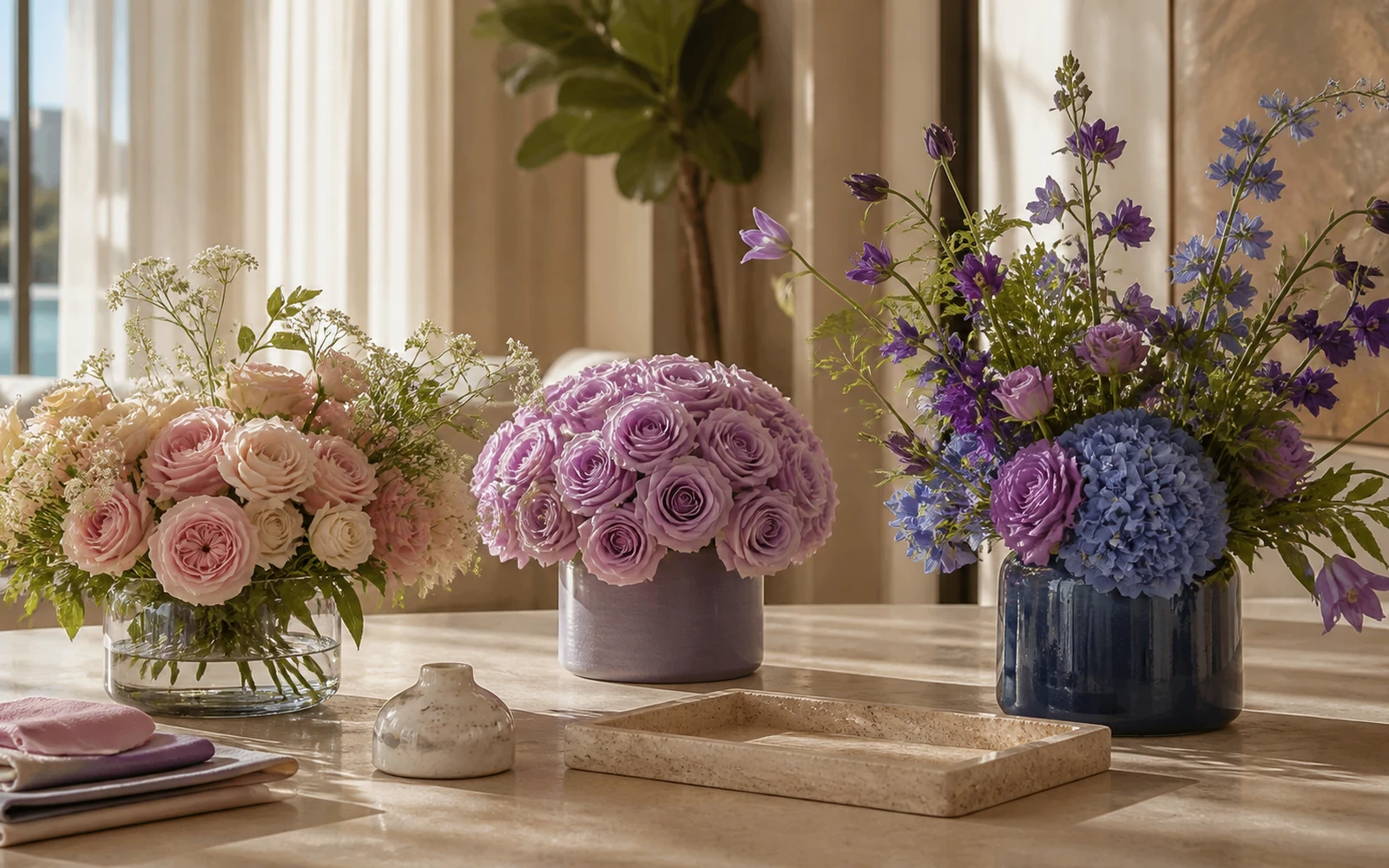
The best flowers for her begin with two questions: what do you know about her taste, and what does this relationship need to say today? Color, silhouette, flower familiarity, home style, and display setting tell you more than the label “wife,” “girlfriend,” “mother,” “friend,” or “partner.” Then the message—romance, gratitude, celebration, repair, or simple care—sets the emotional volume.
Start with one detail she already chooses for herself: a color, a flower, a room style, a favorite object, or a memory. That detail gives the bouquet a personal center.
Use this two-axis shortcut to connect her style with the message:
| What you know about her style | What the moment needs to say | A useful bouquet direction |
|---|---|---|
| she saves soft blush interiors, wears warm neutrals, or loves garden roses | established romance or tender celebration | a softly domed, tonal rose bouquet |
| she repeats one saturated color in clothing, art, or accessories | admiration, birthday, or a confident romantic gesture | a monochrome bouquet with one strong silhouette |
| she likes expressive rooms, mixed color, or sculptural objects | milestone, congratulations, or an energetic thank-you | an airy mixed arrangement in a finished vase |
| she prefers clean lines and uncluttered surfaces | affection without visual excess | a restrained palette and edited shape |
| you know one reliable detail—a favorite color, flower, or room style | care with a personal cue | repeat that detail in the palette or silhouette and explain it in the card |
Start with the current Love and Anniversary collection if the message is romantic, then compare the designs by color, silhouette, and presentation.
Blush-pink and ivory roses create a softly domed, romantic silhouette. Choose this direction when its warmth and garden character match what she already loves.
Lavender roses gathered into a dense, near-perfect dome suit someone whose taste is decisive and color-led.
Blue, pink, and ivory hydrangea, orchids, peonies, roses, and stock create a layered pastel composition. Choose it for someone who prefers varied flower faces and a generous finished design.
Read her visual preferences before choosing a flower
Look for the visual evidence she has already given you.
Color
Notice the colors she repeats when she has a choice: clothes, nail color, phone case, art, tableware, home textiles, or saved images. Repetition gives you a strong palette clue.
If her spaces are warm and quiet, ivory, blush, peach, or muted green may fit. If she collects saturated blue, purple, orange, or red, a stronger palette may feel much more personal. If she dresses almost entirely in black and white, a restrained monochrome arrangement could make more sense than a pastel garden mix.
Shape
Some people love a clean dome; others want movement, negative space, and stems that feel less controlled. A compact round bouquet reads differently from an asymmetrical vase arrangement even when both use roses.
Match the silhouette to what she already chooses. Minimal interiors can support an edited shape; layered rooms can carry more texture and color when that connection is genuinely hers.
Familiarity
A flower gains meaning through association. It may remind her of a garden, a trip, a family table, a wedding bouquet, or a color she has always claimed as her own. The Society of American Florists’ guidance on flower meanings notes that flower meanings come from varied sources and that personal associations can define a present-day gift.
Use symbolism as inspiration after checking her own associations. When she has a clear favorite, let that personal meaning lead.
Setting
The place receiving the flowers is part of her preference. A wrapped bouquet asks her to find a vase, add water, and arrange stems. A vase design arrives more complete but needs a stable surface and enough space. A broad basket has a different footprint from either.
For an office, condo, hotel, or busy household, practical fit can be the most thoughtful style decision you make.
Set the emotional volume with the card
Once the style is clear, decide what the gift should communicate now.
| Moment | Flower direction | Card focus |
|---|---|---|
| established romance | a flower, color, or shape tied to shared history | name the memory or detail you chose |
| newer romance | one specific color cue in an easy-to-receive format | say what you enjoyed or appreciated |
| gratitude | her own palette with a warm, composed silhouette | name the action, lesson, or support you value |
| friendship | a recognizable color, shared reference, or bright mixed vase | make the celebration or care unmistakably friendly |
| apology | a familiar favorite in a calm presentation | say what you are sorry for and what you will change |
For a birthday, start with the recipient-led choices in Best Birthday Flowers. For a romantic milestone, use the relationship and occasion framework in Anniversary Flowers. The same style-first method carries into Mother’s Day flowers and Valentine’s Day flowers beyond the automatic red-rose choice. When the moment is grief rather than celebration, our sympathy flowers etiquette guide focuses on destination, presentation, and an easy-to-receive handoff.
Choose the format around her day
Before ordering, picture the handoff:
- At home: Does she have a vase, a safe surface, and room for the arrangement?
- At work: Can the building receive flowers, and will she need to carry them home?
- At a hotel: Is the reservation name correct, and how does the property handle deliveries?
- At a condo: Are unit, access, recipient phone, concierge, or security details complete?
- In person: Would she enjoy carrying and unwrapping a hand-tied bouquet?
Rosa Fiora’s current Delivery Policy explains how managed properties route flowers through reception, concierge, security, or another receiving area. Complete access details help the handoff feel effortless.
If you know the message but need help with the style, request a custom bouquet direction with the occasion, date, delivery area, and one visual clue. The team can translate it into a bouquet that feels recognizably hers.
The decision I would make
I would identify one piece of visual evidence from her life, choose the emotional message, and select the format that fits her day. Then I would compare the designs that bring those three choices together.
That order keeps the bouquet focused on the person receiving it.