Flower Food: What Works, What’s Useless, and What Can Ruin Your Bouquet
What belongs in vase water, what does not, and why sugar alone is not the shortcut many bouquet owners expect.
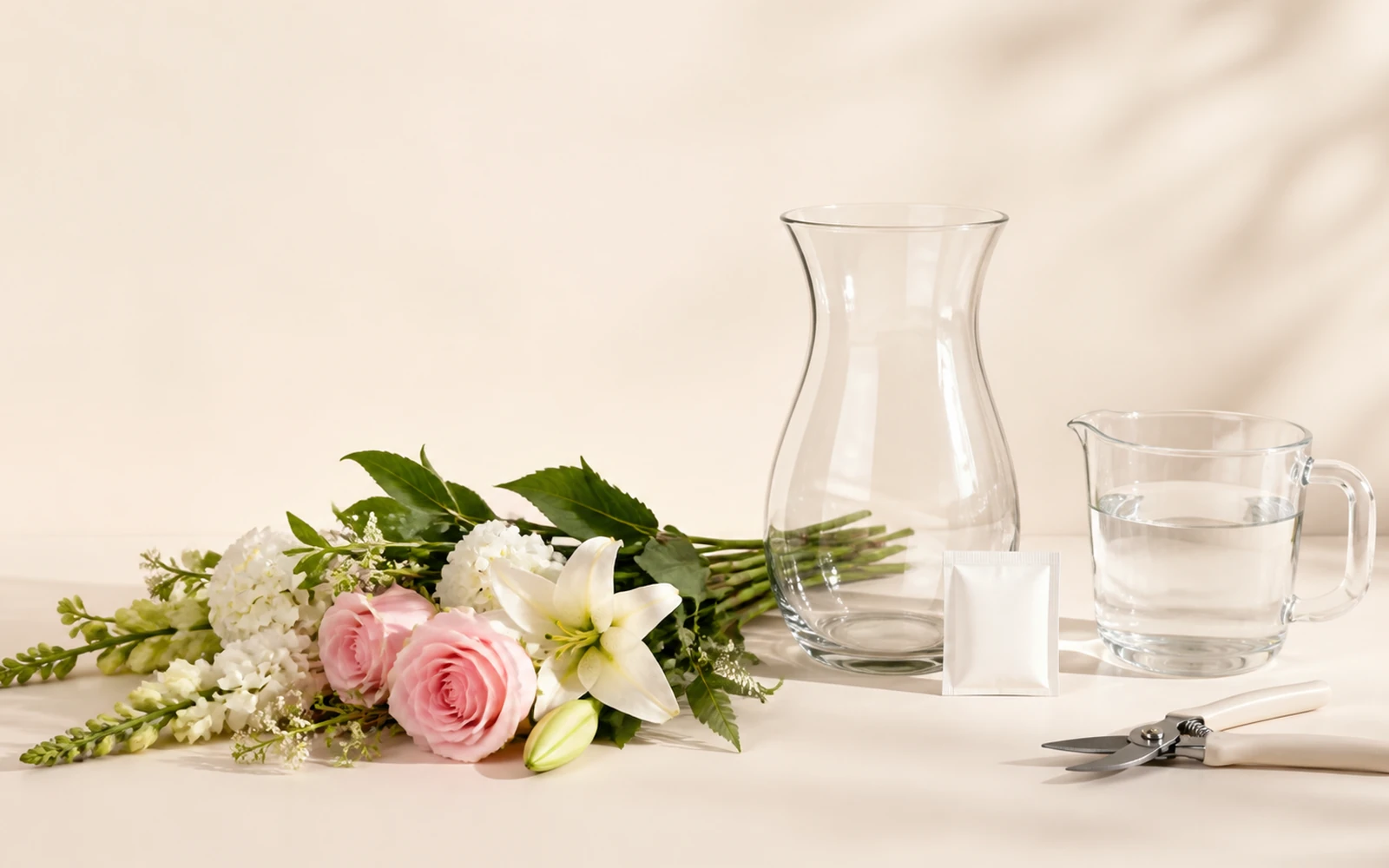
Flower food works when it delivers three things in the right balance: carbohydrate for the cut flower, an acidifier that helps the vase solution move through the stem, and microbial control that keeps the water cleaner. Use a commercial packet at its exact stated water volume. If you have no packet or cannot measure it correctly, put the flowers in clean water in a thoroughly washed vase rather than inventing a stronger mixture.
Here is the short version:
| Put in the vase | My verdict |
|---|---|
| Commercial flower food, measured exactly | Use it |
| Clean water when the correct food is unavailable | Good fallback |
| Sugar alone | Useless as a complete formula—and it can make the water worse |
| A penny or coin | Leave it out |
| Aspirin | Not a dependable substitute |
| Vodka or other alcohol | Leave it out |
| Bleach poured “by eye” | Potentially damaging |
| A pantry cocktail of sugar, citrus, vinegar, soda, and bleach | Too easy to mismeasure for a mixed bouquet |
What commercial flower food actually does
“Food” is a friendly name for a preservative solution. The packet is not simply sugar with floral branding.
It supplies carbohydrate
A flower is still metabolically active after cutting. Buds continue to open, petals develop, and the stem uses stored carbohydrate. Sugar can support that process—but only at a concentration the flower can tolerate.
That last point matters. UMass Amherst’s floriculture guidance shows that species respond differently: some benefit from added sugar, some need very little, and some can be damaged by concentrations that suit another flower.
It acidifies the solution
An acidifier lowers the pH of the vase solution. In a properly formulated preservative, that helps water move through the flower’s conducting tissue. Pouring vinegar or lemon juice into the vase does not recreate that measured formula. You cannot judge vase-water chemistry by eye.
It controls microbial growth
The water contains organic material from stems and leaves. Microbes can multiply, and that growth can obstruct water uptake. A commercial formula includes microbial control at a concentration designed for the job.
This is why sugar alone fails. It contributes one part of the system while also creating a better food source for microorganisms.
Blush and ivory hydrangeas share one finished basket composition. Even within one flower family, I prefer a balanced commercial product over a universal home recipe: each stem still needs clean water and controlled care.
The additions I would keep out of the vase
Sugar by itself
Sugar has a real role in cut-flower physiology, which is why this myth sounds convincing. But a spoonful of sugar in water has no acidifier and no microbial control. It is an ingredient, not a finished formula.
More sugar is not more nourishment, either. The useful concentration differs among flowers. UMass lists tulips among flowers for which sugar in the keeping solution is not recommended, while other blooms may benefit from it. A mixed bouquet makes one guessed dose even less sensible.
Tulips make the species difference visible: use the care product supplied for the flowers rather than treating every stem like a rose.
Pennies and other coins
A coin gives you no controlled concentration of carbohydrate, acidifier, or antimicrobial agent. It also tells you nothing about the coin’s metal composition or cleanliness. Leave money out of the water and spend that attention on washing the vase.
Aspirin
Aspirin appears in old flower-care recipes because people connect it with acidity. A tablet still lacks a measured flower-specific carbohydrate concentration and a complete microbial-control system.
Vodka and other alcohol
Alcohol is another dramatic trick in search of a reliable household method. It is not a substitute for correctly formulated flower food, and an improvised dose can expose delicate stem and leaf tissue to a concentration never intended for it.
Bleach measured by eye
An antimicrobial component can belong in a preservative. An unmeasured splash of household bleach is a different thing.
Household formulations and strengths vary, bleach breaks down in solution, and flowers differ in sensitivity. UMass notes that biocides can discolor stems in some flowers. I would not gamble a bouquet on a capful, a splash, or a recipe copied without the strength of the actual product.
Never mix household cleaning products. For flower care, use the floral packet or step back to clean water.
Why homemade flower food is harder than it looks
A technically complete DIY formula needs the right carbohydrate concentration, the right acidity, the right antimicrobial concentration, compatible water, and a bouquet that responds well to that combination. Then it needs to be remade and the vase cleaned often enough to remain useful.
That is a lot of variables for a gift on the dining table.
Some university extension sources publish measured home formulas. I still would not treat one as the answer for every bouquet, because the same research also shows that sugar response varies sharply by flower. Tulips, chrysanthemums, zinnias, lilies, and gerberas do not all want the same solution.
My practical ranking is simple:
- Best: the commercial food supplied for the flowers, diluted exactly as directed.
- Next best: an appropriate commercial cut-flower food with clear mixing instructions.
- Fallback: clean water, a clean vase, a fresh stem cut, and no improvised additives.
The concentration mistake that can ruin good flower food
A packet made for one quart of water should not be tipped into a small bud vase. The powder may dissolve, but the concentration is wrong.
University of Illinois Extension warns that too much preservative can do more harm than good. Measure the water first, then add the matching amount of food. If you need half the solution, mix the full packet in the full stated volume in a clean separate container and use what the vase needs. Do not estimate half a packet by the height of the powder.
The reverse mistake matters, too. A packet diluted into far too much water may not deliver the balance it was designed to provide.
When clean water is the better choice
Choose plain clean water when:
- the packet instructions are missing;
- you cannot measure the required water volume;
- the only alternative is a guessed mixture;
- you do not know what was already added to the vase;
- you are about to combine several household chemicals;
- flower-specific instructions direct you away from a generic preservative.
Clean water is a fallback, not magic. Start with a washed vase, make a fresh cut with a clean sharp tool, remove foliage below the waterline, and replace the solution when it becomes cloudy, develops an odor, or collects debris. The complete fresh-flower care routine covers those steps without turning this article into the same guide.
My flower-food rule
Use the right formula at the right concentration—or use clean water. I would rather see a bouquet in a clean, simple vase than in a cloudy experiment built from six pantry ideas.
When you are ready for fresh flowers, choose a Rosa Fiora bouquet, then follow the care packet that comes with the arrangement instead of trying to outsmart it.